Retaining Walls & Hardscapes
Retaining Walls & Hardscapes in West Jordan, UT
Terraces, seating walls, steps, and grade correction built on drain rock and geogrid — because walls fail from water pressure, not from weight.
Terraces, seating walls, steps, and grade correction built on drain rock and geogrid — because walls fail from water pressure, not from weight.
Every retaining wall that fails in this valley failed for the same reason: water got behind it and nothing let it out.
The west bench and the newer subdivisions climbing toward the Oquirrhs are full of lots with a grade problem — a backyard that drops four feet across its width, a side yard cut into a slope, a walkout basement that needs a terrace to be usable. Retaining walls turn that unusable pitch into flat, functional yard.
They're also the most commonly under-built thing in residential hardscaping. The block is the part you see and the cheapest part of the job. What actually keeps a wall standing is the base, the drainage behind it, and — above a certain height — the geogrid reinforcement running back into the hillside.
The parts nobody photographs, listed in the order they go in:
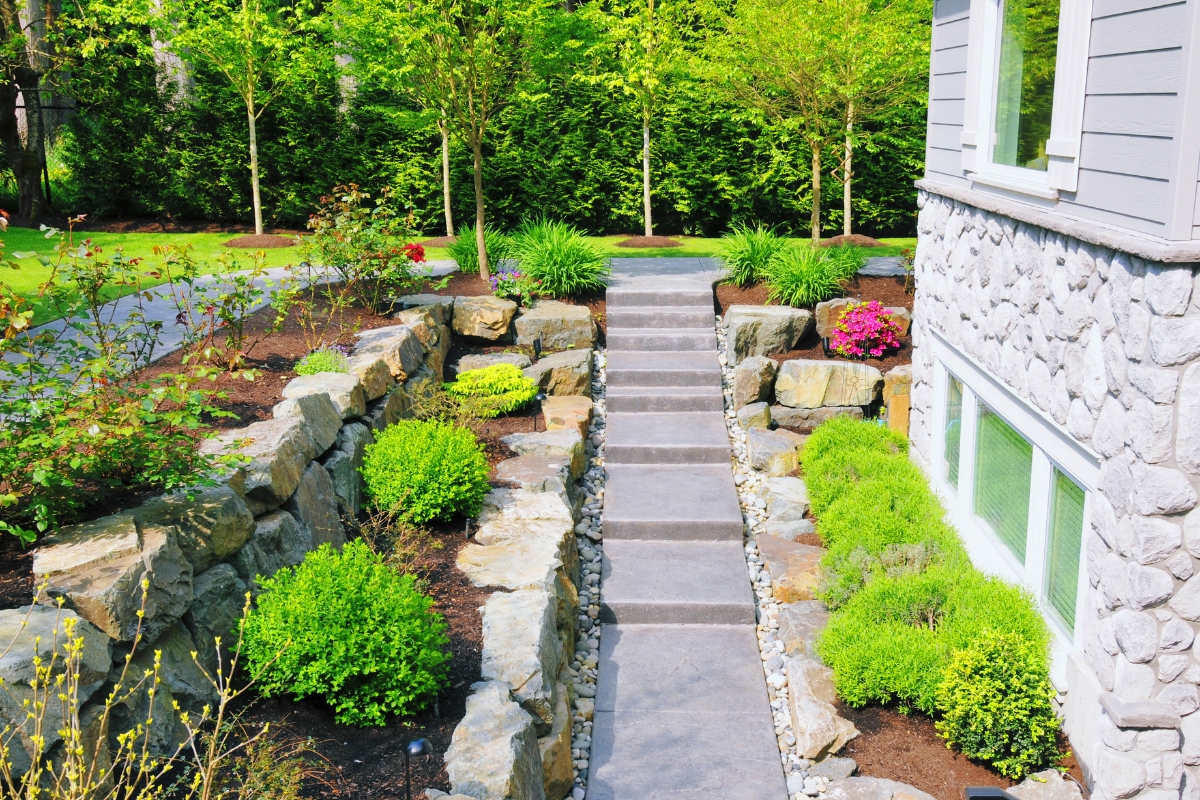
Segmental block walls — the workhorse. Engineered block systems in a range of colors and textures, good for straight runs, curves, and terraces.
Boulder walls — natural stone set with an excavator. More organic, well suited to the foothill lots, and forgiving of irregular grades.
Terracing — two or three shorter walls stepped up a slope instead of one tall one. Often cheaper than a single high wall, and it keeps you under the height that triggers engineering.
Seating walls and planters — low walls that define a patio edge and double as seating.
Steps and stairs — block, poured concrete, or natural stone tying levels together.
| Wall Type | 2026 Installed Cost | Notes |
|---|---|---|
| Segmental block wall, under 3 ft | $35-$60 / face ft | No engineering typically required |
| Segmental block wall, 3-4 ft | $50-$85 / face ft | Geogrid reinforcement included |
| Segmental block wall, over 4 ft | $70-$120+ / face ft | Engineered design and permit usually required |
| Boulder wall | $45-$95 / face ft | Stone size and access drive the range |
| Terraced system (two or three tiers) | $8,000-$25,000 | Often cheaper than one tall wall |
| Seating wall with cap | $60-$110 / linear ft | Cap stone choice matters most |
| Steps, block or poured | $350-$900 per step | Width and rise dependent |
Ranges reflect what we actually quote in West Jordan and the surrounding valley in 2026. Site access, tear-out, and base condition move the number more than anything else — which is why every estimate is written after Bryan walks the property, not over the phone.
Bryan walks the property, scopes it honestly, and delivers a written quote — usually within 24 hours.
Request Your Free EstimateTell us about your project and we’ll get back to you with a detailed quote — usually within 24 hours. No pressure, no obligation.
West Jordan is home base. We work outward from there across the southwest Salt Lake Valley, and up into the north Utah County growth corridor.