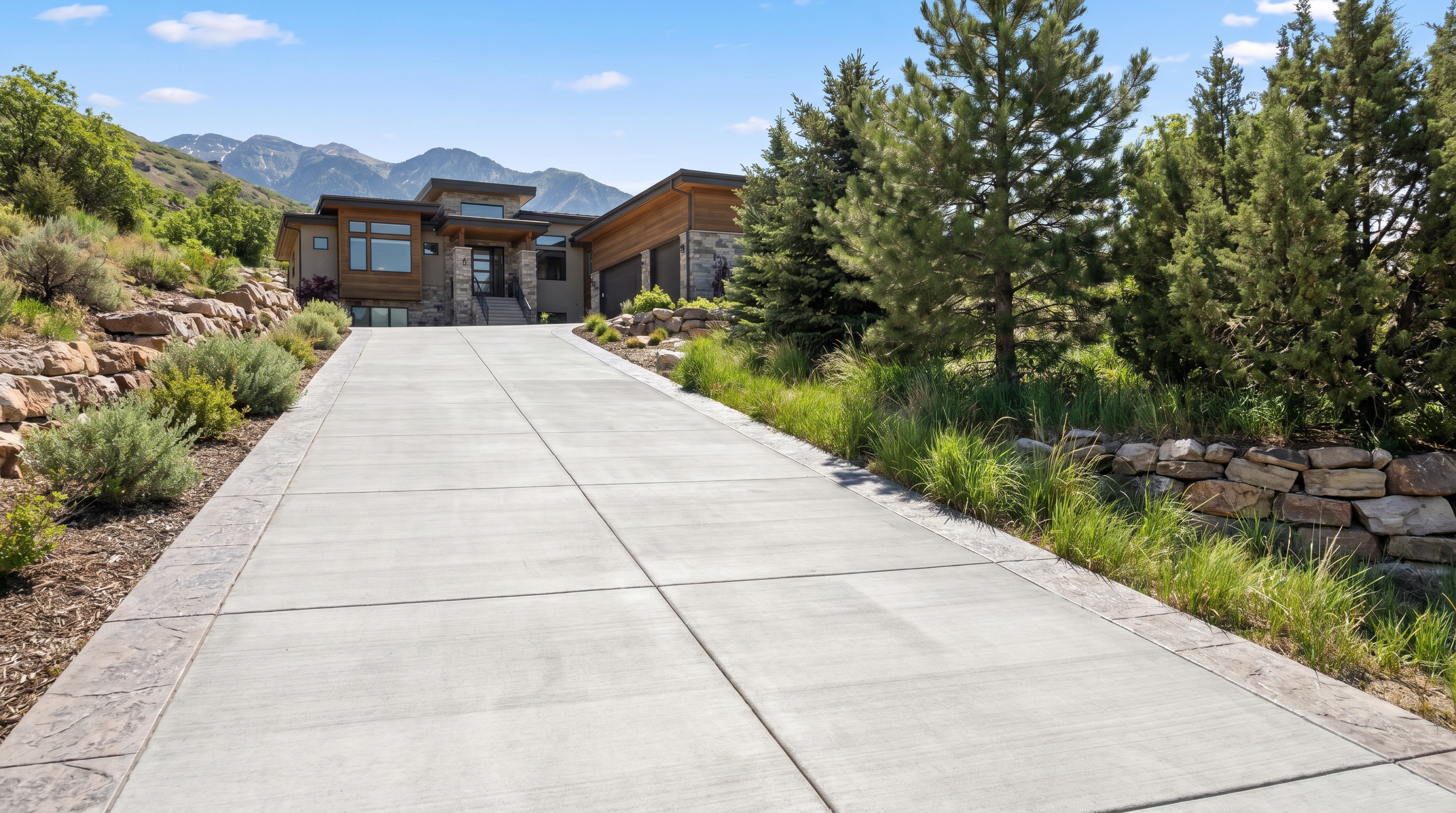
Concrete Driveways for Steep Slopes in Utah: Spec, Cost & Drainage
Quick answer: A concrete driveway on a steep Utah lot needs a thicker pour (5–6”), cross-slope drainage away from the house, a perpendicular broom finish for tire grip, and often a trench drain at the bottom to keep water off the garage slab. Real 2026 cost in the Salt Lake Valley runs $11–$18 per square foot for a standard hillside driveway, $15–$24/sq ft if the project includes retaining walls or major fill. The biggest cost driver isn’t the concrete — it’s the site prep, drainage, and erosion control needed to keep the slab from washing out in its first spring runoff.
If your home is on the bench in Holladay, the foothills above Sandy or Bountiful, the slopes off Wasatch Boulevard, the steep lots in Eagle Mountain, or anywhere in the Park City corridor, you probably already know that a driveway on a hillside is not the same project as a driveway on a flat lot. The slab works harder, the water moves faster, the snow comes off in sheets instead of patches, and a mistake in the pour or grading turns into a real safety and resale problem within a few seasons.
This is the spec we use on steep-slope residential driveways across the Wasatch Front, the costs that come with it in 2026, and the trade-offs every homeowner on a hillside lot should know before they sign a bid.
How Steep Is “Steep” for a Driveway?
The number that matters is grade — the rise over the run expressed as a percentage. Most municipalities and good builder practice define the bands like this:
| Driveway Grade | Rise per 100 ft | Category |
|---|---|---|
| 0–5% | 0–5 ft | Flat — standard residential spec applies |
| 5–10% | 5–10 ft | Moderate — minor spec adjustments |
| 10–15% | 10–15 ft | Steep — full hillside spec needed |
| 15–20% | 15–20 ft | Very steep — engineering review recommended |
| 20%+ | 20+ ft | Maximum — many cities cap at 20%, some at 18% |
Most Utah municipalities cap residential driveways at 20% maximum grade (some specifically at 18%), with the rule that the first 20 feet from the public right-of-way must be less than 5% to give vehicles a flat staging zone before the climb. If your bid doesn’t account for that transition, the contractor doesn’t know the code.
Above 12% grade, you’ll notice it. Low-clearance cars scrape the front lip in winter when the apron freezes. Above 15%, you’re committed: snow tires are a real consideration, and the driveway design needs to actively shed water.
The Right Slab Spec for a Steep Utah Driveway
A flat-lot driveway in the Salt Lake Valley is poured at 4” thick, 4,000 PSI, with fiber or rebar reinforcement. That spec doesn’t hold up on a slope. Here’s why and what changes:
- Thickness: 5” minimum, 6” preferred. A loaded vehicle decelerating downhill or accelerating uphill puts more shear load on the slab than the same vehicle on flat ground — especially at the upper and lower transitions.
- Concrete strength: 4,500 PSI minimum (vs the standard 4,000). Hillside slabs see more freeze-thaw cycles per winter because runoff keeps them wetter longer.
- Air entrainment: 5–7% — required for any exterior Utah pour and especially important on slopes where water sits on the surface.
- Reinforcement: #4 rebar grid on 18” centers in both directions. Fiber alone is not enough on a slope. The rebar prevents the slab from breaking apart along its length once cracks form.
- Base: 6” of compacted 3/4” road base — deeper than the 4” standard — over compacted, geotextile-stabilized native soil if the slope shows any erosion history.
- Control joints: Sawcut every 10 feet across the slope (not parallel to it). This is critical — control joints running downhill catch and channel water under the slab.
- Finish: Broom direction perpendicular to the slope (across the driveway, not down it) for tire traction in winter.
If your bid spec for a steep driveway looks identical to a flat-lot bid spec, the contractor is going to under-build it. The difference in concrete and labor is small. The difference in service life is huge. Our deeper post on how thick a concrete driveway should be walks through the underlying math.
Drainage: The Real Decider on a Hillside Lot
Concrete on a slope is mostly a drainage problem with some concrete on top. Three things have to happen for the driveway to survive 25+ years:
1. Water Has to Leave the Slab Sideways, Not Down It
The slab should be crowned slightly (raised in the center) or sloped to one side, so water moves off the driveway laterally instead of running its full length. Picture a 100-foot-long driveway with water flowing down its entire length: by the time it reaches the bottom apron, it has gathered speed, picked up grit, and is hitting the garage door or the street at a force that erodes everything in its path.
Crown or cross-slope, typically 1/4” per foot, directs that water onto landscape strips or a perimeter drain before it accumulates.
2. There Has to Be a Trench Drain at the Bottom
If the driveway terminates at a garage on a downhill lot, a trench drain (channel drain) across the apron in front of the garage is non-negotiable. Without it, every spring melt and every summer thunderstorm sends water straight into the garage. The drain catches the runoff and routes it via buried pipe to daylight downhill or to a curb cut at the street.
Skipping the trench drain is one of the most common ways homeowners get burned. It looks fine in fall when the driveway is dry. The first February melt floods the garage.
3. The Sub-Base Has to Stay Dry
Water that gets under the slab is the enemy. On a hillside lot, water has plenty of routes under a slab — from above (cuts in the hillside), from the sides (uphill runoff hitting the slab edge), or from below (groundwater rising into the base). Mitigation includes:
- A French drain along the uphill edge of the driveway to intercept hillside runoff before it reaches the slab
- Sealed slab edges with polyurethane joint sealant where the driveway meets retaining walls or landscape
- A drainage swale along the side property line that doesn’t belong to the driveway itself
The bid should explicitly call out drainage. If drainage isn’t a line item, it’s not in the price.
Retaining Walls and Cut/Fill
A lot of hillside driveways require a retaining wall on one or both sides. Two scenarios:
Uphill Retaining
The slope above the driveway has to be held back so it doesn’t slide onto the slab. Typical solution: a 2–5 ft tall block retaining wall along the uphill edge, with a drainage gravel layer and weep holes behind it. For walls over 4 feet, most Utah cities require an engineered plan.
Downhill Support
If the driveway is built up on fill, the downhill edge needs to be supported. A 2–6 ft wall along the downhill side prevents the fill from sloughing off and taking the slab with it. This wall faces gravity loading and freeze-thaw rotation and needs proper footing depth — usually 36” or below frost line in the Salt Lake Valley.
Retaining walls roughly double the cost of a steep driveway project. Build them once, right. The cheapest fix later is full demolition and rebuild.
What a Steep-Slope Driveway Actually Costs in Utah (2026)
| Scope | Per Sq Ft Installed | Typical Project Range |
|---|---|---|
| Moderate slope (5–10%), no retaining | $10–$14 | $5,000–$11,000 |
| Steep slope (10–15%), minor drainage | $11–$15 | $7,500–$15,000 |
| Steep slope + uphill French drain + trench drain | $13–$17 | $10,000–$20,000 |
| Steep slope + retaining wall (one side) | $15–$20 | $14,000–$26,000 |
| Steep slope + retaining walls (both sides) | $18–$24 | $20,000–$40,000+ |
| Major cut/fill or engineered design | $20–$30+ | $28,000–$60,000+ |
Common add-ons:
- Tearout of old asphalt or concrete: $2–$5/sq ft (more if rebar-reinforced or thick)
- Site grading and fill compaction: $1,500–$8,000 depending on volume
- Trench drain at bottom apron: $1,200–$2,800 installed with discharge piping
- French drain along uphill edge: $25–$45/linear foot
- Stamped or colored finish (less common on hillsides): +$3–$8/sq ft
- Heating elements (snow melt system): $12–$22/sq ft for the heated zone — rare for full driveways, more common for the steep section only
- Engineering stamp / soils report: $1,200–$4,000 if required by city for walls over 4 ft or grade over 18%
For comparison to a standard flat-lot driveway, see our Utah concrete driveway cost guide. The per-square-foot price on a hillside is typically 30–60% higher because of base prep, drainage, and reinforcement — not because the concrete itself costs more.
Pour Day Logistics on a Slope
Pouring on a slope is genuinely harder than flat work. Things the homeowner should know:
- The concrete mix is stiffer. A standard 4,000 PSI mix slumps and runs downhill. Hillside pours typically use a lower-slump mix (3” vs 5”) so it stays where the crew places it.
- Pump trucks are usually required. A standard chute pour relies on gravity to move the concrete from the truck to the forms. On a steep lot the truck often can’t get above the highest part of the driveway, so a concrete pump is needed. Adds $400–$1,200 to the project.
- Pour direction matters. Crews pour uphill (placing concrete at the bottom first, working upward) so the slope isn’t carrying wet concrete downward into the lower sections during finishing.
- Finishing window is shorter. Concrete on a slope sets a little faster because air and sun reach more of it. Crews stage finishers along the length so the slab gets broomed before the upper end gets ahead of them.
The right pour window in Utah for a hillside driveway is mid-May through early October. Outside that window you fight either freezing nights or extreme heat — both make a slope pour harder. See our when to pour concrete in Utah guide for the full seasonal calendar.
Common Mistakes We See on Steep-Slope Driveways
Pouring Standard 4” Thickness
The most common cost-cutting move on a hillside bid. The slab cracks transversely within 3–5 years from the shear stress of vehicles braking on the downhill section. Once it cracks, water gets into the sub-base and the failure accelerates.
No Trench Drain at the Garage
Skipping the $1,200 drain to save money on a $15,000 project. The first winter, the homeowner discovers why it’s standard practice.
Broom Finish Pulled Lengthwise
Broom marks running down the slope channel water along their length and offer minimal tire grip in winter. Marks pulled perpendicular to the slope catch water in micro-grooves and give tires bite. Same finish, different direction, completely different winter behavior.
Ignoring the Uphill Property
If the lot above yours doesn’t have an erosion plan, their runoff is your problem. Hillside driveways need to account for what’s coming from above — even on neighboring property — with French drains, swales, or retaining built into the design.
Cheap Sub-Base Compaction
The slab can be perfect, but if the base under it isn’t properly compacted in 4” lifts, the first wet spring will move it. The sub-base on a slope is the most expensive thing to redo — you can’t fix it without tearing out the slab. Our post on why cheap concrete bids cost more covers the broader pattern.
Picking the Right Contractor for a Hillside Driveway
Most concrete contractors in the Salt Lake Valley pour flat-lot driveways every week. Fewer have real volume on hillside work. Things to ask before signing:
- How many hillside driveways have you poured in the last two years? Can I see one?
- What thickness, PSI, and reinforcement are you specifying, and why for a slope?
- What’s your drainage plan — both uphill and at the apron?
- Is a pump truck included or extra?
- Are retaining walls in scope or separate?
- Have you worked with [my city]’s grading and permitting requirements?
- What’s your warranty if the slab cracks or the base settles?
Our broader guide on choosing a concrete contractor in Salt Lake City covers the rest of the vetting process.
Our Take
Hillside driveways are the project where the difference between a budget contractor and a real one shows up fastest. On a flat lot, a slightly under-built driveway will give a homeowner 15 years before cracks become a problem. On a steep slope, the same shortcut shows up in 3–5 years — the slab cracks across the steepest section, water gets into the sub-base, and what looked like a $14,000 driveway becomes a $30,000 replacement.
Build the right spec once: 5–6” thick, 4,500 PSI, rebar grid, perpendicular broom, drainage handled both above and below the slab. The premium over a budget bid is typically 20–30%. The life-cycle savings is multiples of that. If your lot has any real grade to it, that math is one of the easier home-improvement decisions you’ll make.
Pouring a Driveway on a Hillside Lot?
We pour hillside driveways across the Wasatch Front — Holladay bench, Sandy foothills, Bountiful, Park City corridor. Free walkthrough, full grading and drainage plan included in every quote.
Get Your Free Estimate