How Long Before You Can Drive on New Concrete? Utah Cure Timeline (2026)
Quick answer: Walk on it at 24–48 hours. Park a passenger car on it at 7 days. Keep trucks, trailers, RVs, and moving vans off until 28 days. Concrete reaches only about 70% of its design strength in the first week — the last 30% takes three more weeks, and Utah’s heat and cold both change the clock. The most expensive mistake is the earliest one: turning a car onto a 3-day-old slab near the unsupported edge.
This is the question every client asks the day we finish the pour, usually while the crew is still loading the truck. Fair enough — a driveway you can’t use is a driveway-shaped inconvenience. So here’s the real timeline, why it works that way, and where the exceptions are.
The Timeline
| When | What’s OK | What’s Not |
|---|---|---|
| 0–24 hours | Nothing. Stay off entirely. | Footprints, pets, bikes, sprinklers running onto the surface |
| 24–48 hours | Foot traffic | Anything with wheels heavier than a stroller; dragging trash cans |
| Day 3–6 | Foot traffic, light hand equipment | Cars — even “just for a minute” |
| Day 7 | Passenger cars and light SUVs, parked away from slab edges | Trucks, trailers, boats, RVs, turning sharply in place |
| Day 28 | Full design strength — trucks, RVs, moving vans, normal life | — |
| Day 30+ | Sealing (once fully cured and dry) | Sealing too early traps moisture and blushes the finish |
Why the long tail? Concrete doesn’t “dry” — it hydrates. Water chemically bonds with cement, and that reaction builds strength on a curve: roughly 50% at three days, 70% at seven, and the design strength — typically 4,000+ PSI for the driveways we pour — at 28. A car on day 7 is fine because the slab has most of its strength and a sedan is a modest load spread over four contact patches. A loaded moving van on day 10 is a different physics problem, which is why the 28-day number matters most on exactly the projects where people are moving in.
Utah’s Weather Moves the Clock
- Summer heat speeds the surface and stresses the slab. In July and August valley heat, the surface stiffens fast — which fools people into loading it early. Early strength gain is real in warm weather, but so is plastic shrinkage stress; the full breakdown of how we pour around 95° days is in our summer heat pouring guide. Warm-weather pours can often take a car right at day 7 with confidence.
- Cold slows everything down. Hydration nearly stops below about 40°F. A slab poured in late October that spends its first week under frosty nights is not at 70% on day 7 — treat shoulder-season pours as 10–14 days before vehicle load, and true winter pours as a conversation, not a rule of thumb. Seasonal pour windows are mapped in the best time to pour concrete in Utah.
- Edges are the weak point all year. Most early-load damage we see isn’t a crack through the middle of a panel — it’s a chipped or cracked edge where a tire rolled across the unsupported perimeter before the concrete could take it. Enter and exit square to the driveway, away from edges and corners, for the first month.
- First winter: no salt. At all. Concrete in its first freeze-thaw season is at its most vulnerable, and deicing salts amplify the damage mechanism we detailed in how Utah freeze-thaw destroys concrete. Use sand for traction the first winter, shovel promptly, and seal in the fall if the pour cured through summer.
What We Do on Our Pours (So the Timeline Holds)
- Cure compound or wet cure on every exterior pour — holding moisture in during the first days is worth more PSI than any admixture upgrade.
- Saw-cut control joints on schedule — cut too late and the slab picks its own crack lines during exactly this early period.
- Sprinklers off the slab for the first 48 hours, then normal. If we’ve just re-plumbed your irrigation as part of a bigger yard project, we set the schedule before we leave.
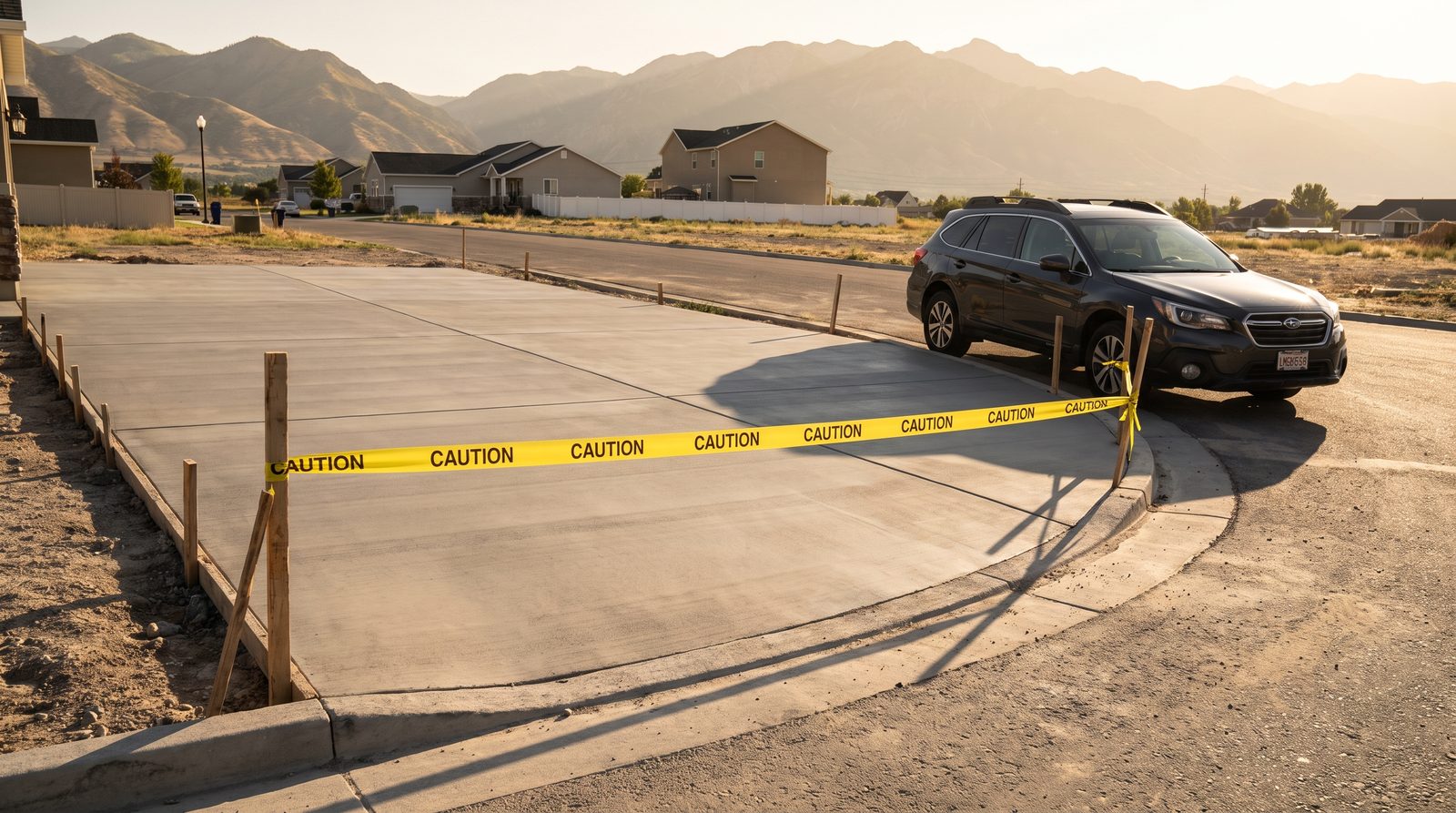
- Barricade tape while it matters — mostly for the neighbor’s dog and the pizza guy, honestly.
- A written care sheet — the timeline above, plus sealing timing, so nobody is guessing in February.
The Questions That Follow This One
- “Can I at least park half on the new slab?” No — a half-on, half-off load concentrates weight on the edge, the weakest part of the youngest concrete. It’s the worst version of early loading, not a compromise.
- “The finisher said 3 days. Who’s right?” Some crews say 3–5 days for cars, and on a hot-weather pour with good mix design they’ll usually get away with it. We quote 7 because the cost of being wrong is a crack you look at for 25 years, and the cost of being right is four extra days of street parking.
- “Does thicker concrete change the wait?” Thickness changes what the slab can carry at full strength — a 5–6” reinforced RV pad still needs its 28 days before the motorhome parks on it. Spec details in how thick a driveway should be.
- “My new driveway already has a hairline crack — was it loaded too early?” Not necessarily; some hairline cracking is normal shrinkage. What early loading causes is edge damage and structural cracks that follow the load path. If you’re not sure which you’re looking at, the diagnostic table in our repair vs replacement guide sorts it out.
Planning a Pour Before the Season Turns?
August and September pours cure in ideal conditions and are fully drivable before the first freeze. Free estimates, usually within 24 hours — and every pour comes with the care timeline in writing.
Get Your Free Estimate