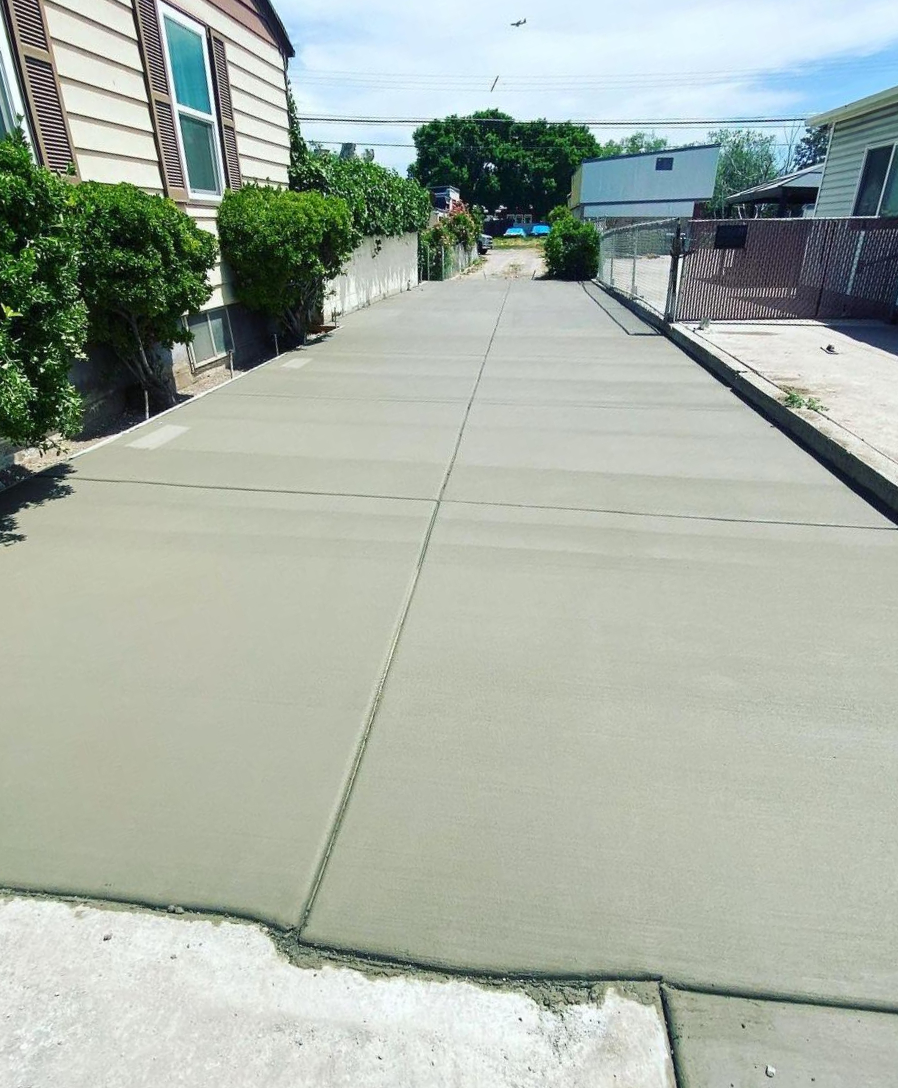
Concrete Pouring in Utah Summer Heat: The 90-Day Rule, Plastic Shrinkage Cracking & Pour-Day Timing
Quick answer: Utah summer pours fail differently than winter pours. The dominant failure modes are plastic shrinkage cracking (surface tears as water evaporates faster than it can bleed up), rapid moisture loss (concrete sets too fast and never reaches design strength), and thermal stress cracking (slab expansion against fixed edges). The countermeasures are a pour-day temperature cap of 90°F ambient with mix temp under 85°F, an early-morning pour window (5–9 AM) on days forecasting above 88°F, evaporation retarder applied immediately after screeding, a 7-day wet cure, and the 90-day rule — no de-icer, no concentrated load, and ideally no first-frost exposure for 90 days after the pour. Skip any of these and a perfectly-spec’d slab can still fail in its first 12 months.
In April I published a guide on how Utah freeze-thaw damages concrete. Today, on June 8, the back-half of that conversation: heat. Utah is one of the few markets in the lower 48 that punishes concrete at both extremes — 100–130 freeze-thaw cycles in winter, and then 60–80 days a summer where ambient hits 90°F+ with single-digit humidity. The pour-day mistakes that produce a slab with hairline plastic-shrinkage cracking aren’t mistakes the homeowner can see when the contractor leaves at 5 PM. They show up at month 2 or month 6, and they’re mostly irreversible.
This is the field guide for anyone considering a summer pour in Utah — what changes about the mix, the pour window, and the cure, and what to ask the contractor before the truck arrives.
Why Utah Summer Is Brutal on Fresh Concrete (in a Different Way)
Three Utah climate variables stack against summer pours:
- High ambient temperature. The Salt Lake Valley averages 30–45 days per summer at 90°F+, with regular 95°F+ stretches in July. St. George and the southern Utah corridor are routinely 105–110°F.
- Low relative humidity. Utah summer afternoon RH commonly drops to 8–15%. Concrete in Houston sees 60–80% RH for the same calendar day — meaning the moisture gradient driving evaporation in Utah is 3–5× stronger.
- Solar load and wind. Wasatch Front pour sites get full unfiltered sun from 8 AM to 7 PM with intermittent canyon-wind events. Surface evaporation rate is a function of all four variables — air temp, mix temp, humidity, and wind speed — and Utah maxes out three of them.
The American Concrete Institute publishes a nomograph in ACI 305 (Hot Weather Concreting) that converts these four inputs into an evaporation rate. The threshold to watch is 0.2 lb/sq ft per hour — above that, plastic shrinkage cracking becomes likely. A typical Utah July afternoon pour without countermeasures sits at 0.3–0.5 lb/sq ft per hour. That’s 1.5–2.5× the cracking threshold, with no margin.
The Three Failure Modes Heat Produces
1. Plastic Shrinkage Cracking
The most common summer-pour failure. Surface water evaporates faster than bleed water rises from inside the slab to replace it. The drying surface contracts; the still-wet concrete underneath doesn’t. The result is thin, parallel surface cracks — often diagonal across the slab, often spider-web patterns at corners, sometimes just hairlines you don’t notice until winter when they fill with water and become freeze-thaw initiation sites.
- Cause: Surface evaporation rate over 0.2 lb/sq ft/hr during the first 2–6 hours after placement.
- Damage timeline: Visible within 1–24 hours of pour, often before the contractor leaves. Frequently missed because the slab still looks gray and uniform.
- Repair: Largely cosmetic only. Crack injection and surface re-coat hide it but the surface is permanently weaker.
- Prevention: See the countermeasures section below.
2. Rapid Set / Under-Strength Concrete
Concrete reaches design strength through a chemical reaction (hydration) that depends on water staying in the mix for 28 days. In hot, dry, windy conditions, that water evaporates out of the slab before the hydration is complete. The slab cures — it’s hard — but the resulting concrete is 15–30% weaker than the design spec called for.
- Cause: Mix water lost to evaporation during the 7-day primary cure window.
- Damage timeline: Invisible at handover. Shows up as accelerated wear, surface scaling, and reduced freeze-thaw resistance in years 3–10.
- Repair: None. The slab’s strength was set during cure and can’t be re-cured.
- Prevention: 7-day wet cure (water, curing compound, or both).
3. Thermal Cracking
A freshly placed slab heats up from the exothermic hydration reaction (concrete generates heat as it cures), and from solar load. Hot concrete expands; when it cools at night it contracts. If the slab is restrained by anything fixed (foundation, existing concrete, an embedded fence post), the contraction produces tension cracks at the restraint points.
- Cause: Temperature differential of more than 30°F between slab interior and surface during the first 72 hours.
- Damage timeline: Visible at days 2–7. Cracks at corners, fillets, and any tie-in to existing structures.
- Repair: Crack injection on the cosmetic issue; the structural restraint problem can’t be fixed retroactively.
- Prevention: Lower placement temperature, isolation joints at restraints, properly spaced control joints.
Pour-Day Timing: The 5–9 AM Window
The single highest-leverage decision on a Utah summer pour is what time the truck arrives. The math: every 10°F of ambient temperature roughly doubles the evaporation rate during the first hour after placement. Pouring at 6 AM on a 90°F-forecast day means the first 2 hours of cure happen in 70–75°F ambient. Pouring at 1 PM the same day means the first 2 hours happen in 88–92°F.
| Forecast High | Pour Window | Special Measures |
|---|---|---|
| Under 80°F | Anytime, 7 AM–3 PM | Standard cure protocol |
| 80–88°F | 6 AM–11 AM ideal | Evaporation retarder; light fogging |
| 89–95°F | 5–9 AM only | Chilled mix water; cooled aggregates; evaporation retarder; sunshades for crew comfort |
| Over 95°F | Reschedule or pre-dawn pour | Full ACI 305 hot-weather protocol; ice in mix water; cooled aggregates |
| Wind 15+ mph regardless of temp | Wind block required | Wind triples evaporation rate — never skip |
A 5 AM start is genuinely uncommon, even among good Utah contractors. If you’re scheduling a summer pour and the contractor says "we’ll be there at 9 or 10," ask what their hot-weather protocol is. The answer "we add water on site" is a red flag — that violates the water-cement ratio and produces weaker concrete than the original mix design. The right answer involves time-of-day adjustment, evaporation retarder, and a cure plan, not on-site water.
For the full seasonal pour window logic, see our best time to pour concrete in Utah guide.
Mix Adjustments for Summer Pours
If the calendar requires a summer pour, the mix itself can be modified to extend working time and reduce thermal load:
- Retarder admixture: Chemical additive that slows the initial set without reducing final strength. Buys 30–90 minutes of working time. Standard on any Utah pour above 85°F.
- Type II or Type IV cement: Lower heat-of-hydration than standard Type I/II. Produces less internal heat as the slab cures. Useful on large pours (300+ sq ft single placement).
- Chilled mix water or ice: Reduces mix temperature. Specifying mix temp under 85°F (and ideally 70–75°F) cuts evaporation and thermal load by 15–25%.
- Lower water-cement ratio (max 0.45): Less free water to evaporate. Combined with a water-reducing admixture (mid- or high-range) to maintain workability.
- Fly ash partial cement replacement: 15–25% fly ash replacement reduces heat of hydration and improves long-term durability. Cost-neutral to slightly cheaper.
- Air entrainment: Still 5–7% — non-negotiable for Utah. The freeze-thaw protection matters in winter even if the pour was in July.
For the broader spec framework that applies year-round, see our post on how thick a concrete driveway should be.
The 7-Day Cure (Where Most Summer Pours Fail)
What happens in the first 7 days after placement is more important than the spec, the contractor’s reputation, or anything else. Concrete reaches roughly 70% of design strength in those 7 days — only if it stays wet enough to keep the hydration reaction running.
The three viable cure protocols for Utah summer:
- Wet burlap or wet curing blankets (gold standard). Cover the slab once final finishing is complete, keep continuously wet for 7 days. Labor-intensive but produces the highest-strength result. Used on commercial and high-spec residential pours.
- Curing compound (most common residential). Sprayed-on membrane forming a vapor barrier over the slab surface. Less labor; slightly lower ultimate strength than wet cure. Acceptable for driveways and patios in Utah if applied correctly within 30 minutes of final finishing.
- Plastic sheeting (acceptable for small pours). Polyethylene sheeting laid over the slab and weighted. Cheap but condensation patterns can produce uneven cure color. Acceptable on sidewalks and small pads.
What does NOT work in Utah summer: simply hosing down the slab once a day. The surface dries out in 20–40 minutes in 90°F low-humidity conditions — you’d need to be present to re-water every half-hour for 7 days straight. Either commit to a real cure protocol or schedule the pour for a different month.
Ask the contractor explicitly what cure protocol they’re using. If the answer is "we don’t do anything special, it cures fine," that’s a contractor whose work is going to be 15–30% weaker than its design strength.
The 90-Day Rule
Even after the 7-day primary cure, concrete continues to gain strength for months. The slab reaches roughly 90% of design strength at 28 days and full strength at 90 days. During that 90-day window, the slab is more vulnerable to:
- De-icer attack: Never apply any de-icer in the first 12 months after placement, but especially not in the first 90 days. The cement matrix hasn’t fully hydrated and chloride penetration is much faster.
- Concentrated loads: No moving trucks or loaded trailers on the slab in the first 28 days. Light vehicles only after day 7.
- First-frost exposure: A summer pour that hits its first hard frost before 90 days is at elevated risk of freeze damage. This is why late-October pours are actively bad in Utah — the slab can’t reach full strength before winter.
- Heavy stamping or saw-cutting: Control joints should be saw-cut at 12–48 hours (not day 7). Decorative stamping happens during placement, not after.
The practical implication for a Utah homeowner pouring in June or July: the slab will reach full design strength sometime in September or October — well before the first hard frost. A pour in early August is also safe under the 90-day rule. A pour in September is borderline; pour in October only with heat blankets and accelerator.
What to Ask Before the Truck Arrives
If you’re scoping a summer pour, three questions tell you whether the contractor actually has a hot-weather protocol or is treating it like any other day:
- "What time does the truck arrive?" If the forecast is 88°F+ and the answer is anything later than 9 AM, push back. The right answer is 5–7 AM.
- "What’s your cure protocol?" The right answer names a specific product or method — curing compound brand name, wet burlap, plastic sheeting timing. The wrong answer is "it cures fine, we don’t do anything special."
- "What’s the maximum mix temperature you’ll accept from the supplier?" The right answer is under 90°F (ideally 75–85°F). The wrong answer is "whatever they bring."
Concrete is one of the few residential trades where the contractor’s on-site decisions in a 6-hour window decide whether the slab lasts 30 years or 15. Hot-weather discipline is one of the cleanest filters for separating contractors who understand the chemistry from contractors who pour the same way in February and August. See our broader vetting framework in how to choose a concrete contractor in Salt Lake City.
Should You Delay the Pour?
The general rule on a Utah summer pour: if you can move the pour to a different week of the year for the same project, the math almost always favors moving. Late September through mid-October at valley-floor elevations is the cleanest pour window in Utah — cool enough to avoid evaporation problems, warm enough to complete the 28-day primary cure before frost.
Where summer pours make sense:
- The project has a hard deadline (e.g., backyard work needs to be done before a family event).
- The contractor has explicit, documented hot-weather experience and a written cure plan.
- You can commit to the 5 AM–9 AM pour window.
- You’re willing to pay 5–10% more for chilled mix and evaporation retarder.
Where summer pours are usually a bad idea:
- The forecast is 100°F+ and the contractor wants to pour at 10 AM.
- The contractor can’t name a specific cure protocol.
- The project is large (over 500 sq ft single placement) and the day forecasts wind over 15 mph.
Our Take
Utah is the only state I’ve worked in where the spec, the season, and the cure all have to be right to get a 30-year slab. Pour in summer with the wrong protocol and you’ve baked in 10–15 years of lifespan loss before the first car ever parks on it. The countermeasures are well-known and inexpensive — chilled mix water, an early pour time, a real cure protocol — but they require a contractor who runs hot-weather pours differently than spring pours.
If you’re pricing a summer concrete project right now and three of three bids quote you the same number and the same protocol they’d use in May, that’s a signal. The right Utah contractor in July adjusts the truck time, the mix, and the cure plan — and explains why on the walk-through.
Our deeper post on why cheap concrete bids cost more in Utah covers the broader trade-off; hot-weather protocol is one of the line items that distinguishes a $9 per sq ft bid that lasts 30 years from a $7 per sq ft bid that fails at year 12.
Pouring Concrete in Utah This Summer?
We run summer pours at 5–7 AM, spec chilled mix water above 85°F forecast, and walk every cure plan with the homeowner. Free on-site bid — we’ll tell you straight whether your project should pour now or in September.
Get Your Free Estimate