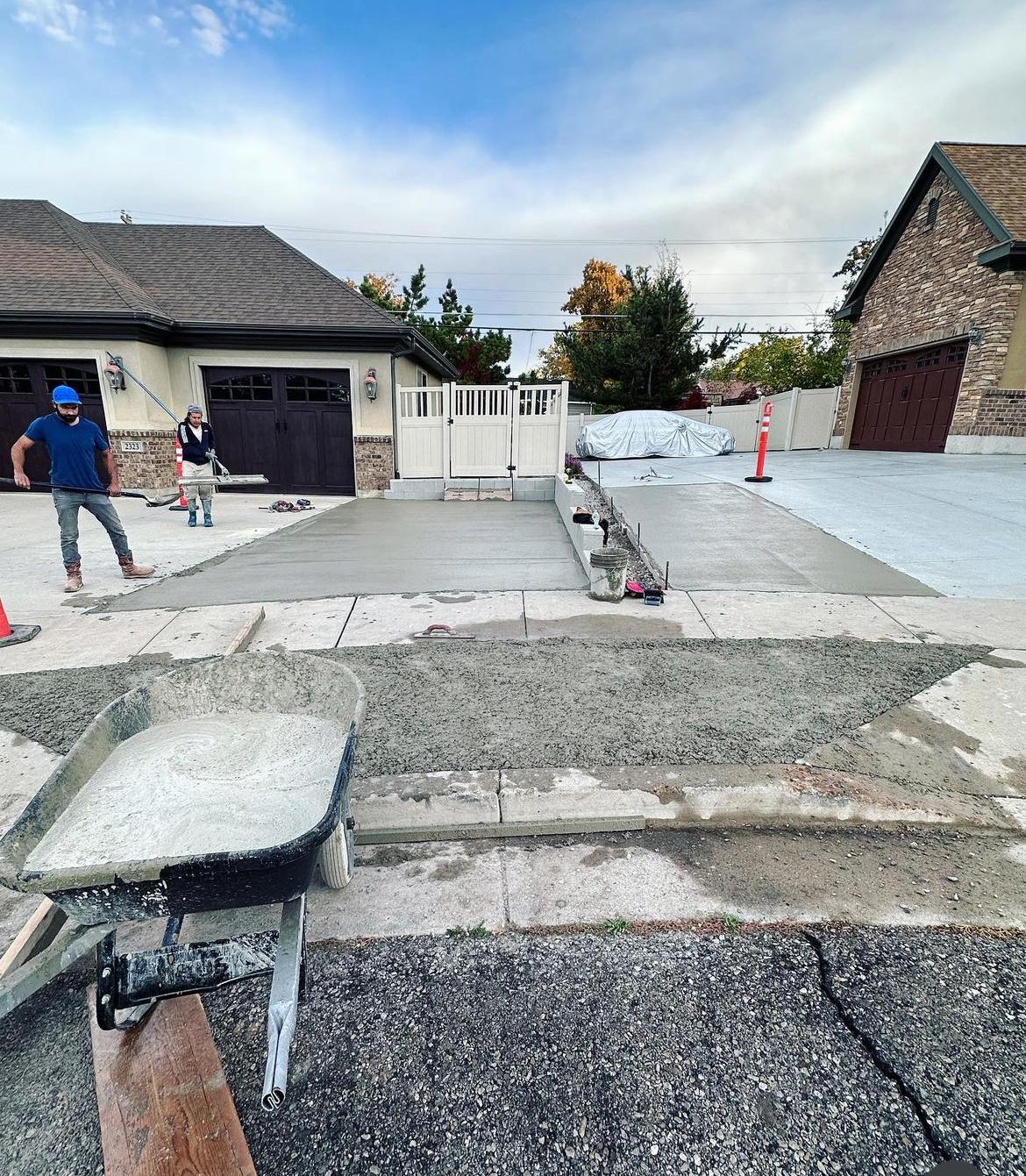
How Utah Freeze-Thaw Affects Concrete: Damage Patterns, Prevention Spec & Repair Timing
Quick answer: The Wasatch Front averages 100–130 freeze-thaw cycles per year — roughly double what concrete in Texas sees and meaningfully more than Colorado’s Front Range. Each cycle, water trapped in concrete expands ~9% and creates internal pressure; without the right spec, that pressure produces scaling, spalling, joint failure, and eventually structural cracking. The three spec choices that decide whether a slab survives Utah winters are 4,000+ PSI concrete with 5–7% air entrainment, a penetrating siloxane sealer applied year 1 and every 3–5 years thereafter, and calcium-chloride-free de-icer use during winter. Damage caught at the scaling stage is repairable for $200–$800 per area; damage that reaches deep spalling or rebar exposure usually requires panel replacement at $7–$13 per sq ft.
If you live anywhere from Bountiful down to Lehi, up Parley’s into Park City, or across the bench from Holladay to Draper, every piece of concrete on your property is being slowly worked on by freeze-thaw. Most homeowners don’t notice the early stages, because the damage is microscopic for the first 3–7 years. By the time it’s visible on the surface, the slab has already lost a meaningful fraction of its useful life — and the choice between an $800 repair and a $9,000 replacement is usually decided by whether someone caught it in time.
This post is the field guide I wish every Utah homeowner had before pouring concrete or buying a house with a driveway that’s already seen ten winters. What freeze-thaw actually does, how to identify the four damage patterns it produces, the spec that survives it, and the repair timing math that protects the slab’s remaining life.
Why Utah Is Uniquely Brutal on Concrete
Two climate variables matter for concrete: how many times the temperature crosses 32°F per year, and how much moisture is in the slab when it crosses. Utah scores high on both.
- Freeze-thaw cycle count. The National Weather Service’s long-term records for the Wasatch Front show 100–130 cycles per year at valley-floor elevations (SLC, Provo, Bountiful). The bench and foothill neighborhoods (Holladay, Sandy bench, Bountiful bench) see 110–140. Park City and the Wasatch Back see 140–170. Mountain corridors above 8,000 ft (Brian Head, Powder Mountain area) push 180+.
- Moisture loading. A wet spring snowpack melt, summer monsoonal moisture, and the irrigation patterns of Wasatch Front lawns mean concrete here is rarely dry. Concrete is porous — the surface acts like a sponge during a wet weather window.
- The 32°F whipsaw. Utah’s spring and fall produce the worst pattern: 50°F daytime, 20°F overnight. That’s 30° of swing across the freezing point in 12 hours. Each swing is one cycle.
- De-icer accelerant. Magnesium chloride and calcium chloride brines used on Utah roads transfer onto driveways via vehicle tires. Both chemically attack concrete, accelerating the surface damage that freeze-thaw started.
The combination is the reason a 1990s-era 3,000 PSI residential driveway with no air entrainment that’s still serviceable in Phoenix is usually pitted, scaling, and structurally compromised after 20–25 years in Utah.
The Mechanism (One Paragraph)
Water absorbed into the concrete’s pore network freezes at 32°F. Frozen water occupies ~9% more volume than liquid water. With no place to expand, the ice creates internal hydraulic pressure inside the concrete matrix. If that pressure exceeds the concrete’s tensile strength, microscopic cracks form. Next cycle, more water enters those cracks, freezes, expands, and the cracks grow. Over many cycles, microscopic damage compounds into visible surface scaling, then into spalling (chunks breaking off), then into structural cracking. Air entrainment — intentionally adding 5–7% by volume of microscopic air bubbles to the concrete mix — gives the expanding ice somewhere to go and is the single most important freeze-thaw defense.
The Four Damage Patterns — How to Identify Them
Freeze-thaw damage shows up in four distinct visual patterns. Diagnosing the pattern tells you what spec failed, what stage the damage is at, and whether you can repair or need to replace.
1. Surface Scaling
Thin, flaky surface failure — looks like the top 1/8” to 1/4” of the slab is peeling off in shallow patches. Most common on the side of the driveway nearest the street (where de-icer drips off the car) and on patios that don’t get sealed.
- Cause: No or inadequate air entrainment in the mix, plus de-icer exposure and/or no sealer.
- Stage: Early-to-mid damage. The structural slab is usually still sound underneath.
- Treatment: Surface grind and re-coat, or polymer-modified overlay. Cost: $4–$8/sq ft. Buys 8–15 years if sealed afterward.
2. Spalling
Chunks of concrete breaking off — usually starting at edges, corners, control joints, or around rebar. Visible as 1”–3” deep pockets where material is missing.
- Cause: Advanced freeze-thaw, often combined with insufficient cover over rebar (less than 2”) or steel that’s started to rust and expand.
- Stage: Mid-to-late damage. Structural integrity at the spall site is compromised.
- Treatment: Localized patch repair if the spall is isolated and shallow ($150–$500). Full panel replacement if spalling extends past a single area or rebar is exposed ($7–$13/sq ft installed). See our spring repair checklist for the inspection sequence.
3. Joint Failure / D-Cracking
Parallel crack patterns running along control joints, or hairline cracks spreading out from joint intersections in a "D" shape. Often accompanied by joint sealant separation.
- Cause: Water entering at the joint, freezing, and progressively widening the crack each cycle. Joints are the most vulnerable part of any slab.
- Stage: Mid-stage. If caught early, joint resealing prevents progression. If left, leads to spalling and structural cracking.
- Treatment: Clean and reseal joints with polyurethane sealant ($3–$8 per linear foot). On older slabs with widened joints, saw-cut wider and refill.
4. Structural Cracking
Wide cracks (over 1/4”), cracks with vertical displacement, or cracks that cross the full panel diagonally. These are the kind that compromise load-bearing capacity.
- Cause: Late-stage freeze-thaw progression, often combined with base settlement, undersized slab thickness, or missing rebar.
- Stage: Late damage. The slab is structurally compromised.
- Treatment: Full panel replacement, almost always. Crack injection is a cosmetic-only fix on a structural crack — it doesn’t restore load capacity. See why cheap concrete bids cost more for the math on why patching late-stage damage is usually false economy.
The Spec That Survives Utah Winters
If you’re pouring new concrete in Utah — driveway, patio, sidewalk, RV pad, hot tub pad, retaining wall footing — these are the non-negotiables. Skip any of them and you’re building in a 20–30% lifespan penalty before the first winter.
| Spec | Minimum for Utah | Why It Matters |
|---|---|---|
| Concrete strength | 4,000 PSI minimum | Higher tensile strength resists the hydraulic pressure from expanding ice |
| Air entrainment | 5–7% by volume | The single most important freeze-thaw defense — gives expanding ice somewhere to go |
| Water-cement ratio | 0.45 maximum | Less water = fewer pores = less moisture to freeze |
| Slab thickness | 4” sidewalks, 4–5” driveways, 5”+ rentals/STRs | Thicker slabs survive cycles longer and resist structural cracking |
| Rebar cover | 2” minimum from surface | Steel within 1” of the surface rusts, expands, and accelerates spalling |
| Curing time | 7 days minimum wet cure | Properly cured concrete reaches higher density and lower permeability |
| Sealer | Penetrating siloxane, year 1 and every 3–5 years | Reduces water absorption by ~80% — less water in the slab means less freeze damage |
| Joint sealant | Self-leveling polyurethane in all control joints | Stops water from entering at the most vulnerable point |
The two most common spec failures I see when bidding repair or replacement on existing Wasatch Front driveways from the 1990s and 2000s: no air entrainment, and rebar placed too close to the surface. Both were "savings" the original contractor made that ended up costing the homeowner 10–15 years of slab life.
Sealer Choice (the Single Biggest Maintenance Lever)
The single highest-ROI maintenance action a Utah homeowner can take on concrete is sealing it on year 1, then resealing every 3–5 years. Sealer reduces water absorption by ~80%; less water means less freeze damage. Three sealer categories to know about:
- Penetrating siloxane / silane: The right choice for Utah driveways and patios. Invisible after application, doesn’t change appearance, doesn’t make the surface slippery, lasts 3–5 years. Cost: $0.20–$0.50/sq ft DIY, $0.80–$1.50/sq ft professional.
- Acrylic topical sealer: Cheaper and easier to apply but creates a film that wears off in traffic patterns within 1–2 years, can turn cloudy or yellow, and can become slippery when wet. Acceptable for low-traffic patios and decorative concrete; avoid on driveways.
- Penetrating densifier (lithium silicate): Used mostly on commercial polished concrete. Permanent — chemically reacts with the concrete — but expensive and overkill for most residential applications.
If your driveway has never been sealed and it’s more than 2 years old, a single application this summer is the highest-impact $300–$800 you can spend on the property’s exterior concrete.
De-Icer Choice in Winter
This is where homeowners unknowingly accelerate their own concrete’s failure. Five de-icer chemicals you’ll see on shelves, in increasing order of harm to concrete:
| De-Icer | Effective To | Concrete Damage | Verdict |
|---|---|---|---|
| Sand (no de-icer) | N/A — traction only | None | Best for concrete; doesn’t actually melt ice |
| Calcium magnesium acetate (CMA) | ~20°F | Minimal | Best chemical option; pricey |
| Sodium chloride (rock salt) | ~15°F | Moderate — corrodes rebar over time | Acceptable on aged sealed concrete |
| Magnesium chloride | ~5°F | High — chemically attacks cement paste | Avoid on any concrete under 1 year old |
| Calcium chloride | -20°F | Severe — aggressive chemical attack | Avoid on residential concrete entirely |
Two practical rules: never use any de-icer on concrete poured within the last 12 months (the cement hasn’t fully cured yet and is more vulnerable), and prefer sand-for-traction plus a small amount of CMA over volume-applied rock salt or chloride brines.
Repair vs Replace: The Decision Framework
The most expensive mistake homeowners make on freeze-thaw damaged concrete is repairing damage that’s past the point where repair pencils out. The framework I use when walking a property:
- Surface scaling only, slab is structurally sound: Repair. Surface grind and reseal, or polymer-modified overlay. $4–$8/sq ft. Adds 8–15 years.
- Isolated spalling (1–3 areas, each under 1 sq ft), no rebar exposed: Repair. Localized patch and reseal. $150–$500 per area.
- Joint failure with no surrounding cracking: Repair. Clean, saw-cut wider if needed, reseal. $3–$8/linear ft.
- Spalling across more than 30% of the slab, OR rebar exposed anywhere: Replace. Full panel removal and pour. $7–$13/sq ft installed.
- Wide cracks (over 1/4”), vertical displacement, or cracks across the full panel: Replace. Crack injection on structural damage is a cosmetic fix only; it doesn’t restore load capacity.
- Slab is 25+ years old AND showing any of the above: Lean replace. Even successful repairs on a slab past its design life buy 5–8 years, not 30. The math usually favors replacing now if you’re going to be in the home for 5+ more years.
For specific cost framing on full replacement, see our Utah concrete driveway cost guide — and for the contractor-vetting framework, how to choose a concrete contractor in Salt Lake City.
Best Time to Repair or Pour in Utah’s Climate
Freeze-thaw repair and replacement work has a tighter weather window than most other concrete work because the patch or the new pour needs 28 days of above-freezing weather to reach full design strength.
- Best window: Late April through mid-October at valley-floor elevations; mid-May through late September at bench and Park City elevations.
- Worst window: Late October through mid-March — the first hard frost can damage curing concrete inside the 28-day window even if the surface looks dry.
- Acceptable with extra cost: November and March pours are possible with heat blankets and accelerators, but add 8–15% to the cost.
- For sealer application: Two consecutive dry days at 50°F+, ideally between June and September. Don’t seal in spring while the slab still holds melt moisture — you’ll trap water inside.
Our full seasonal guide on the best time to pour concrete in Utah goes deeper on the pour-window logic.
The Spring Walk-Through Every Utah Homeowner Should Do
Once a year, ideally in late March or April after the last hard frost but before the surface dries out, walk every concrete surface on the property with a tape measure and a phone camera. You’re looking for:
- New surface scaling that wasn’t there last year — photograph and measure the area.
- Joint sealant that’s separated, cracked, or missing — flag for re-sealant this summer.
- Any spall larger than your thumbnail, especially at edges or corners.
- Cracks wider than the edge of a credit card.
- Any vertical displacement you can feel with a foot or hand.
- Areas where water ponds for more than 24 hours after rain or melt.
Anything on this list goes in a dated log with photos. If you find one item, schedule a single-visit repair this summer. If you find three or more items on the same slab, the slab is in the late stages of its useful life — budget for replacement within the next 1–3 years rather than chasing repairs.
Our spring concrete repair checklist walks through this inspection in more granular detail.
Our Take
Utah is harder on concrete than almost anywhere else in the lower 48. Most of the residential concrete I see fail prematurely in this market wasn’t poorly poured — it was poured to a spec that would have been fine in a different climate. 3,000 PSI concrete with no air entrainment is a perfectly normal residential spec in Houston. Pour it in Sandy and it’ll outwardly look fine for 10 years, then fail in years 12–18.
The two things that determine whether a Utah slab makes it 30+ years vs 15: spec at the pour (4,000 PSI, 5–7% air entrainment, proper rebar cover, 28-day cure) and maintenance afterward (sealer year 1 and every 3–5 years, joint sealant maintained, sane de-icer choices). Neither costs much in the context of the slab’s lifetime, and together they double the practical life of every horizontal concrete surface on the property.
If you’re standing on a slab today that’s scaling, joint-failing, or showing early spalling, the math almost always favors fixing it this summer rather than next. Another winter of freeze-thaw on damaged concrete is the difference between an $800 repair and an $8,000 replacement on a typical 600 sq ft driveway.
Worried About Freeze-Thaw Damage on Your Utah Concrete?
We walk the slab, identify the damage stage, and tell you straight whether it’s a $400 fix or a full replacement. No upsell, no guessing. Free on-site assessment.
Get Your Free Estimate