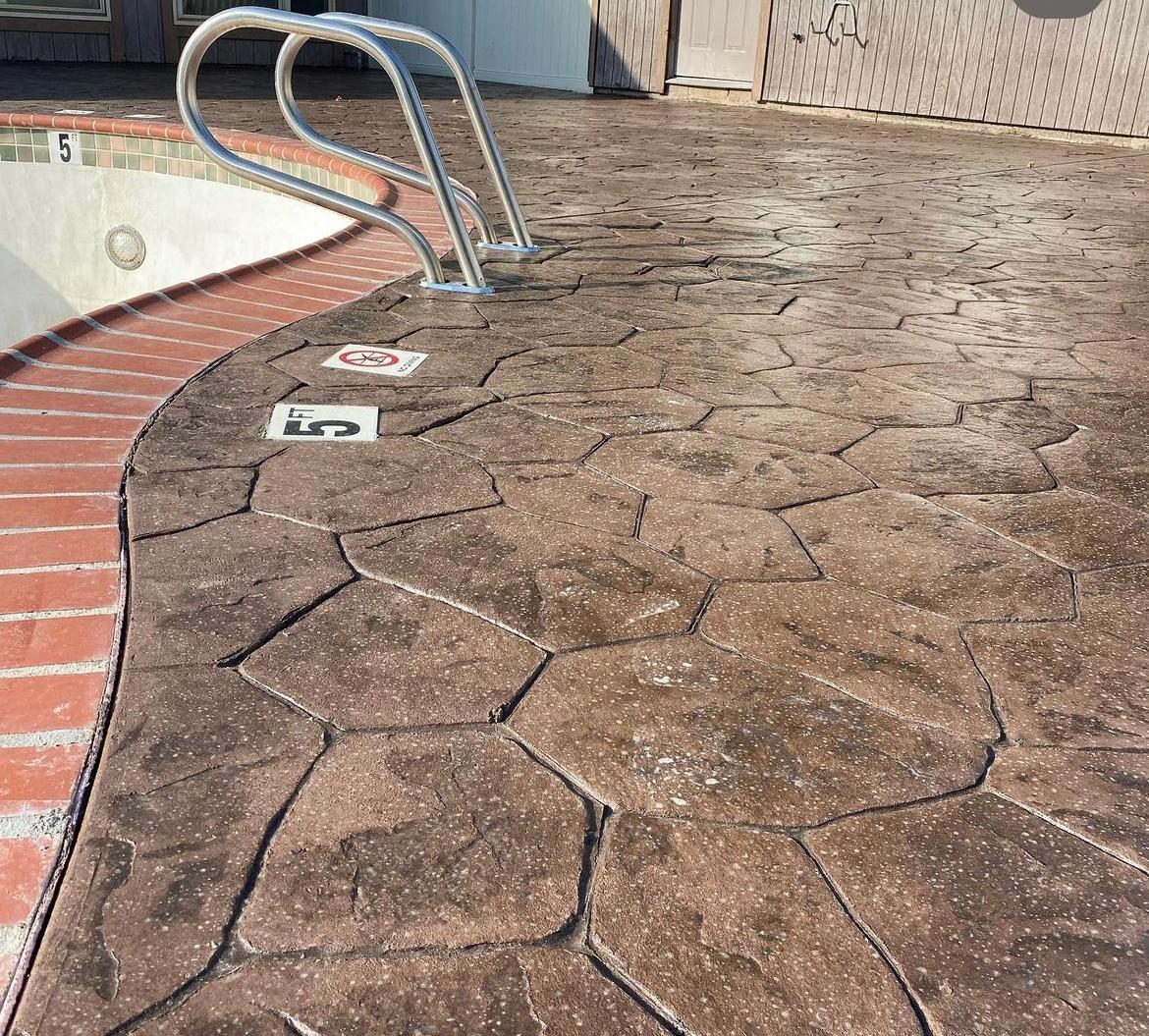
Stamped Concrete for Pool Decks in Utah: Cost, Slip Resistance & Design
Quick answer: Stamped concrete is one of the best pool deck surfaces for Utah backyards — $14–$22 per square foot installed, with the right anti-slip additives and a lighter color it stays cool, grippy, and lasts 25–30 years through Utah’s freeze-thaw cycles. Below: the patterns that work around water, the safety details most contractors skip, and what to budget for a typical 600–1,200 sq ft pool deck.
If you have an inground pool in Utah and your deck is bare gray concrete, paver-edged spalled concrete, or worn-out flagstone, stamped concrete is almost always the upgrade homeowners ask about first. It’s the only material that gives you the look of stone or brick without the joint maintenance, the heat absorption of dark pavers, or the rotting and cracking of wood decks around chlorinated water.
But pool deck stamped concrete isn’t the same job as a stamped patio away from a pool. The slip resistance, the surface temperature, the sealer choice, and the chemistry of repeated chlorine exposure all need to be specified differently. Here’s what changes when the deck wraps a pool.
Why Stamped Concrete Works Well Around Pools
Stamped concrete has four advantages over the alternatives in a Utah pool deck application:
- Continuous monolithic surface. No joints between pieces means no places for chlorinated water, sand, or weeds to collect. Pavers and flagstone always have joints — and those joints fail first.
- Custom shape around curves. Pools rarely have straight-line edges. Stamped concrete pours into any shape; pavers force you to cut and trim hundreds of pieces along the coping.
- Customizable slip resistance. Anti-slip additives can be mixed into the sealer or broadcast onto the surface. You can dial in exactly the level of grip the deck needs.
- Lifespan in freeze-thaw climates. A properly air-entrained, properly sealed stamped concrete deck will outlast wood, composite, and most paver installations along the Wasatch Front.
The flip side: stamped concrete around a pool is a higher-stakes job than a stamped patio in the middle of the yard. Get the slip resistance wrong and someone gets hurt. Get the sealer wrong and the surface fails in 3 years instead of 25. The upside of doing it right is significant; the cost of doing it wrong is too.
Slip Resistance: The Detail Most Contractors Get Wrong
Wet stamped concrete with a glossy sealer is among the slipperiest surfaces you can pour. That’s the version most generic stamped concrete contractors deliver by default — because high-gloss sealers make patterns pop in showroom photos. Around a pool, that’s a liability waiting to happen.
Three ways to add slip resistance, in order of how we typically recommend them for pool decks:
1. Polymer Grit Additive in the Sealer
A fine polymer or aluminum oxide grit (similar texture to fine sand) is mixed into the sealer before application. Once the sealer cures, the grit is permanently embedded in the surface. The texture is barely visible but very effective — it raises the wet coefficient of friction substantially while keeping the look of the stamp pattern intact.
Cost: roughly $0.25 to $0.75 per square foot added to the sealing line item. This is the right answer for nearly every residential pool deck.
2. Broadcast Silica Sand Before Final Sealer Coat
Fine silica sand is broadcast onto the wet first coat of sealer, then a second coat is applied over the top to lock it in. More aggressive grip than polymer grit, slightly more visible texture. Used when the deck has a lot of slope or when there are kids running around.
3. Heavier Texture Stamp Patterns
Choosing a pattern with naturally deeper texture (rough slate vs smooth ashlar, for example) gives you mechanical grip from the pattern itself even without additives. Combine with polymer grit in the sealer and you have one of the safest wet surfaces available.
What to avoid: a smooth-finished stamped pattern with high-gloss solvent-based sealer and no additive. That combination is slick when wet and frankly dangerous around a pool. If your contractor hasn’t talked to you about slip additives unprompted, ask before they pour.
Surface Temperature: Why Color Matters in Utah
Salt Lake City summers run 95–105°F regularly through July and August. Dark surfaces around the pool can hit 140–160°F in direct sun — hot enough to burn bare feet in seconds. This is where pool deck color matters more than aesthetic.
| Color Tone | Approx Surface Temp on a 100°F Day | Barefoot Comfortable? |
|---|---|---|
| White / cream / sand | 120–130°F | Yes (with brief tolerance) |
| Light gray / buff / tan | 125–140°F | Borderline |
| Medium brown / terra cotta | 140–155°F | No, sandals required |
| Dark gray / charcoal / slate | 150–170°F | Burn risk |
For Utah pool decks, we strongly recommend staying in the light-to-medium tonal range — cream, buff, sand, light gray, soft tan. Dark slate or chocolate brown looks great in catalog photos shot in the morning, but homeowners regret it the first July afternoon.
If the homeowner is set on a darker look, ask about cool-deck additives or heat-reflective sealers, which can drop surface temperature by 10–20°F. They cost more and come with their own tradeoffs (some affect slip resistance and sealer longevity), but they’re an option.
Sealer Choice for Pool Decks
The sealer is the single most important specification on a pool deck pour. The wrong sealer fails in 2 to 4 years; the right sealer lasts 5 to 8 years between recoats and protects the underlying concrete for decades. Three categories matter:
Acrylic Sealers
Most common, affordable, easy to apply and re-coat. Fine for most pool decks if the formulation is water-based and rated for pool environments. Avoid solvent-based acrylics around pools — they fume in heat and don’t hold up to chlorine splash as well.
Penetrating Silane/Siloxane Sealers
Soak into the concrete pores rather than forming a surface film. Doesn’t change the look, doesn’t affect slip resistance, lasts 7–10 years. Excellent freeze-thaw protection — which matters a lot in Utah. The trade-off: doesn’t enhance the color or pattern. Best paired with a colored or stained surface that doesn’t need a glossy finish to look right.
Polyaspartic or Polyurea Sealers
Premium option. Cures quickly, extremely durable, UV-stable, chlorine-resistant. Used on commercial pool decks and high-end residential jobs where the homeowner wants 10+ years between maintenance. Cost: 2x to 3x the price of standard acrylic.
What we recommend for most Utah residential pool decks: a quality water-based acrylic sealer with polymer grit additive, recoated every 5–6 years. That’s the cost-to-durability sweet spot.
Pattern and Color Combinations That Work
For pool decks specifically, certain stamp patterns hold up better visually and physically than others:
- Seamless slate or stone texture. No defined “pieces” means no eye-catching repetition around the pool curve. Reads as natural stone. Forgiving on imperfect layouts.
- Random ashlar slate. Mix of large irregular shapes with natural texture. Looks like quarried stone. Pairs well with cream or sand color tones.
- Roman slate or Italian slate. Classic, lighter pattern depth, easy to keep clean. Good for traditional homes.
- Wood plank stamps. Increasingly popular for modern pool decks. Looks like wide-plank decking but with concrete’s lifespan around water. Use with light driftwood-tone color.
Patterns we’d generally avoid around pools: large-scale flagstone with deep grout joints (collects debris and water), small repetitive cobblestone (looks busy along curves), and brick patterns running parallel to the pool edge (the lines emphasize any settling).
What a Pool Deck Project Costs in Utah (2026)
Realistic Salt Lake Valley pricing for a stamped concrete pool deck, including the slip and sealing details above:
| Deck Size | Standard Stamp + Color | Premium Pattern + Sealer Upgrade |
|---|---|---|
| 400 sq ft (small surround) | $5,600–$8,000 | $8,000–$11,500 |
| 800 sq ft (typical pool deck) | $11,200–$16,000 | $16,000–$22,500 |
| 1,200 sq ft (large or wraparound) | $16,800–$24,000 | $24,000–$33,500 |
| 1,800+ sq ft (resort-style) | $25,200–$36,000 | $36,000–$50,500 |
Common add-ons:
- Tearout of existing deck: $2–$4 per sq ft, depending on what’s being removed
- Cool-deck color additive: $1–$2 per sq ft
- Polyaspartic sealer upgrade: $3–$5 per sq ft (vs standard acrylic)
- Coping replacement or integration: $40–$80 per linear foot
- Built-in seating walls or planters: $1,500–$3,500 each
For comparison with non-stamped concrete patio pricing, see our Utah patio cost guide.
Pool Deck vs Pavers: Why Stamped Concrete Usually Wins in Utah
The most common alternative homeowners weigh against stamped concrete for a pool deck is pavers. Here’s the honest comparison for Utah specifically:
| Factor | Stamped Concrete | Pavers |
|---|---|---|
| Installed cost (pool deck) | $14–$22/sq ft | $18–$30/sq ft |
| Installation around curves | Pours to any shape | Requires cutting every edge piece |
| Joint maintenance | None (just resealing) | Re-sand joints every 1–2 years |
| Freeze-thaw response | Holds up if properly air-entrained | Individual pavers can heave or settle |
| Surface temperature | Controllable via color | Often runs hotter due to thickness |
| Repair if damaged | Patch or resurface section | Replace individual pavers (matching can be tricky) |
| Slip resistance | Custom-tuned with sealer additive | Inherent texture, less tunable |
For a deeper side-by-side, see stamped concrete vs pavers. The short version: pavers win on ease of repair if a single piece breaks, stamped concrete wins on virtually everything else for pool deck applications.
Maintenance: What Pool Deck Stamped Concrete Needs Year to Year
Utah’s climate stresses pool decks more than most. Annual maintenance for a properly installed stamped concrete pool deck:
- Spring opening: Pressure wash on a low setting (under 2,500 PSI). Inspect joints and edges for any cracking or settling.
- Mid-summer: Spot-clean any sunscreen, suntan oil, or chlorine residue stains with a pH-neutral cleaner. Avoid acid-based cleaners — they degrade sealer.
- Fall closing: Sweep and rinse before winter. Don’t leave organic debris (leaves, pine needles) sitting on the deck through winter — the moisture they trap is what lifts sealer.
- Every 5–7 years: Reseal. Light pressure wash, repair any cracks or chips, apply 2 coats of compatible sealer with the same slip additive package as the original.
- Avoid winter: Don’t use rock salt or chloride-based deicers. Use sand or calcium magnesium acetate for traction. Rock salt is one of the fastest ways to ruin a pool deck.
Common Mistakes We See on Other Contractors’ Pool Decks
When we’re called out to fix or replace a stamped concrete pool deck that failed early, the same handful of issues show up:
- No air entrainment in the mix. Required in Utah for any exterior pour. Without it, freeze-thaw cracks the slab in 3–5 years.
- Wrong slope. Pool decks need to slope away from the pool (typically 1/4 inch per foot) so splash water and rinse-off don’t go into the pool. Lots of decks are poured flat or backwards.
- No expansion joint between deck and pool coping. When the slab expands and contracts, that joint absorbs the movement. Without it, the coping tile pops loose.
- Solvent-based glossy sealer with no anti-slip. Aesthetic-driven choice with real safety consequences.
- Color matched in showroom lighting. Concrete color reads completely different in Utah summer sun than in a lit indoor showroom. Always pour a sample slab and view it outside before approving.
- Sealer applied too soon after pour. Stamped concrete needs 14–28 days of cure before the final sealer coat. Sealing too soon traps moisture and causes the sealer to whiten or flake within months.
Project Timeline for a Typical Pool Deck
For an 800–1,200 sq ft stamped pool deck in Utah, plan for about 10–14 days from start to fully usable:
- Days 1–2: Tearout of existing deck (if needed), site prep, base compaction
- Day 3: Forms, rebar, expansion joints around pool
- Day 4: Pour, color application, stamping, jointing
- Days 5–7: Initial cure, color hardening
- Day 8: Wash off release agent, light power wash
- Days 9–14: Continued cure (no sealer yet, no heavy use)
- Day 21–28: Final sealer application with anti-slip additive
- Day 30: Fully cured, sealed, and pool-party ready
The right window in Utah is May–June or September–October — warm enough for the stamp work and sealer to behave correctly, not so hot that the slab flash-cures before it’s stamped. We cover the seasonality math in detail in when to pour concrete in Utah.
Our Take
For Utah pool decks, stamped concrete is the right answer for almost every residential application — if it’s specified correctly. The mistakes that ruin pool decks are predictable and avoidable: air-entrained mix, slope away from the pool, expansion joint at the coping, light-to-medium color, anti-slip additive in the sealer, and proper cure time before sealing.
Done right, you get a 25–30 year deck that wraps any pool shape, looks like quarried stone, stays cool enough to walk on barefoot, and grips when wet. There’s no other material that does all of that at the price point. If you’re weighing the upgrade for your backyard, get a contractor who’s built pool decks specifically — not just stamped patios — to walk the project and quote it line by line.
Planning a Pool Deck Project?
We build stamped concrete pool decks across the Salt Lake Valley. Free walkthrough, sample colors on site, and a written quote — usually within 24 hours.
Get Your Free Estimate