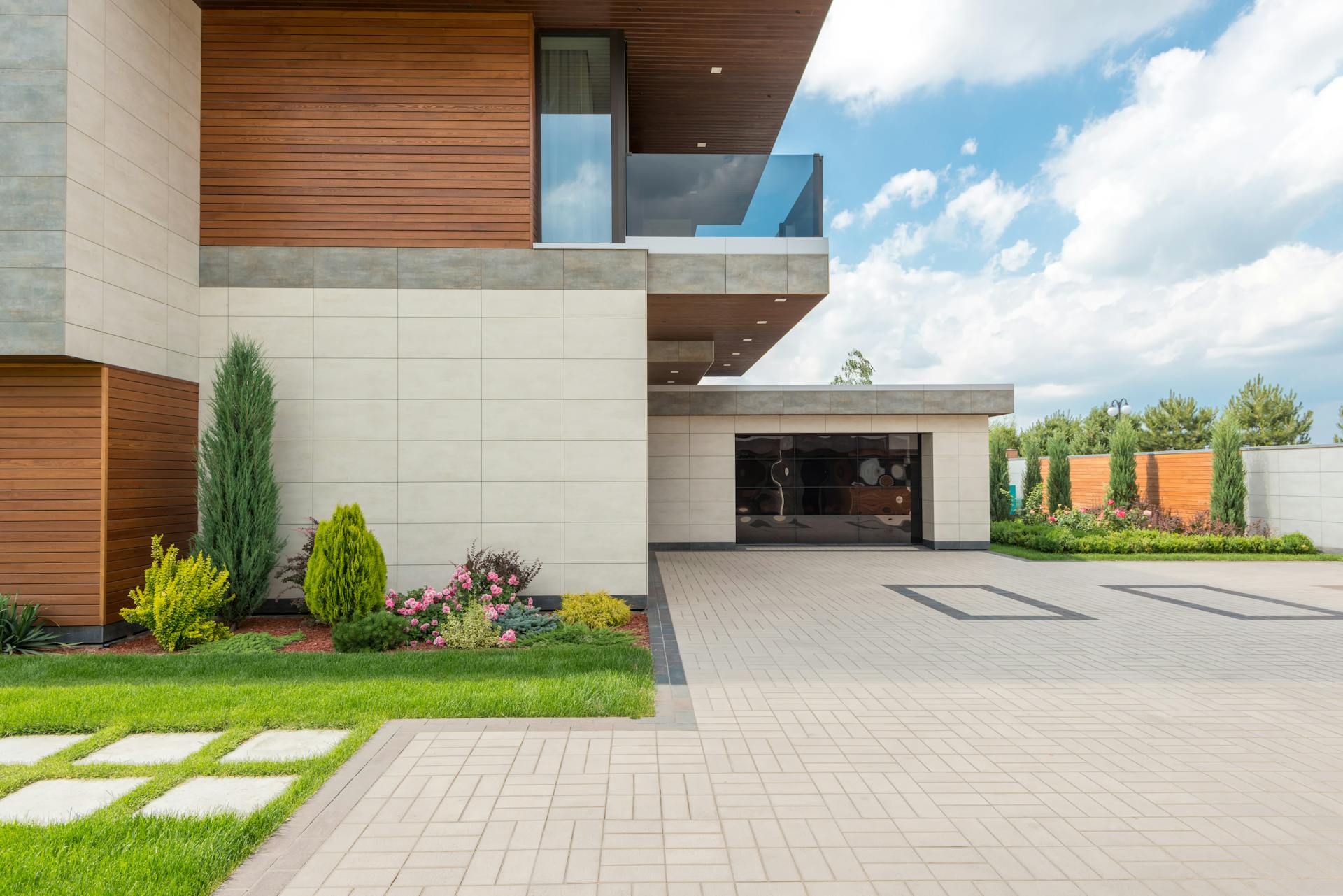
Parking Pad & Driveway Repair for Airbnb & STR Owners in Utah: Cost, Booking-Gap Timing & Review Risk
Quick answer: Replacing a concrete parking pad or short driveway on a Utah short-term rental runs $9–$13 per sq ft installed — typically $3,500–$12,000 total depending on whether it’s a 1-car pad or a 2–3 vehicle driveway. The right operational window is a 5–10 day booking gap, scheduled in the shoulder seasons (April or October at lower elevations, May or September in Park City and the mountain corridors). Spec for STR use: 5” thickness, 4,000 PSI, thickened edges, saw-cut joints — the parking pad takes more abuse than an owner-occupant’s because guests park inconsistently, load roof boxes on the slab, and chain tires on it in winter. Most STR concrete work depreciates as a 15-year land improvement and the days the property is offline during the pour are not a passive-activity loss event if you stay under the 7-day average stay threshold (confirm with your CPA).
If you operate one or more short-term rentals along the Wasatch Front, in Park City, near Moab, in St. George, or any of the gateway markets Utah hosts visit, the driveway or parking pad is the first surface every guest sees and the last one they walk across before leaving a review. It’s also the surface that’s most consistently undersized, under-spec’d, and under-maintained on the listings I get called to bid.
A guest who clips their bumper on a cracked edge, has trouble backing a rental SUV out of a tight pad, or slips on a spalled section in winter doesn’t complain to the host privately — they mention it in the review. “Parking is rough” or “the driveway is in bad shape” on three reviews in a row will push the listing’s average rating down half a star and the listing visibility down with it. Concrete that would just be a maintenance item on a long-term rental becomes a revenue line item on an STR.
Why STR Parking Is Different From a Standard Rental
The operational profile of a short-term rental parking surface is meaningfully different from either an owner-occupied driveway or a long-term rental driveway:
- Constant turnover. A 4-night-average STR sees 70–90 distinct vehicles per year vs ~3–5 on an owner-occupied driveway. More tire pressure cycles, more weight variation, more inexperienced parkers misjudging clearance.
- Larger vehicles than the slab was designed for. A 1990s-spec 4” pad was sized for a sedan. The 2026 STR guest in Park City is in a rented Suburban with a roof box and chains. The Moab STR guest is in a 4Runner pulling a UTV trailer.
- Winter chain marks and salt damage. Mountain corridor STRs (Park City, Heber, Wasatch Back, Brian Head, Powder Mountain area) see tire chains scrape the slab and aggressive de-icer use. Both accelerate surface failure.
- Roof boxes loaded on the slab. Guests offload skis, bikes, paddleboards directly on the concrete — including dropped corners and metal stake points that chip edges.
- Tight turning on small lots. Many Utah STRs are converted ADUs, basement suites, or carriage houses on lots where the parking is shoehorned in. Tight turning radii put rotational load on slab edges, accelerating spalling.
- Visibility on the listing. Cracks, weeds growing through control joints, and oil stains show up in listing photos and dating-stamped guest photos. Visual condition has direct revenue impact.
The implication for the spec: the STR parking surface needs to be poured at the high end of the residential range and maintained on a tighter cycle than a standard rental.
2026 Cost Ranges by STR Property Type
| STR Configuration | Typical Surface Area | Per Sq Ft Installed | Typical Total |
|---|---|---|---|
| Basement / ADU rental, 1-car pad | 180–320 sq ft | $11–$14 | $2,000–$4,500 |
| Single-family STR, 2-car driveway | 500–700 sq ft | $10–$13 | $5,000–$9,100 |
| Mountain cabin / Park City type, 3-car + turnaround | 900–1,400 sq ft | $10–$13 | $9,000–$18,200 |
| Duplex STR (shared parking) | 800–1,200 sq ft | $10–$13 | $8,000–$15,600 |
| Tear-out add-on (existing concrete removal) | Same area | $2–$4 | Add 20–30% to base cost |
| Stamped or colored finish upgrade | Same area | +$5–$10/sq ft | Listing-photo value (see note below) |
The stamped/decorative finish question comes up for higher-end STRs (Park City, Deer Valley, Brian Head, gated communities) where the parking surface shows up prominently in listing photos. The math: the upgrade costs $3,000–$6,000 more, and the photo improvement can lift booking conversion meaningfully on a $400+ nightly listing. Lower-tier nightly rates rarely pencil out the upgrade.
For broader cost framing on stamped concrete, our post on Utah concrete driveway cost covers the standard pricing band.
Spec for an STR Parking Surface
The temptation on an STR is to spec for the average guest and the average vehicle. The right move is to spec for the heaviest plausible guest scenario, because that’s the one that produces the bad review:
- Thickness: 5” standard. 6” if the property hosts trailers (Moab UTV-haulers, Park City ski-haulers).
- Concrete strength: 4,000 PSI minimum with 5–7% air entrainment (mandatory for Utah freeze-thaw).
- Reinforcement: #3 rebar on 18” centers in both directions. Fiber-only is sufficient for sedan-only lower-elevation pads but underspec’d for mountain corridor STRs.
- Base: 4” of compacted 3/4” road base over compacted native soil — non-negotiable. Skipping or shorting the base is the leading cause of premature failure on STR pads.
- Edge detail: Thickened edges (6” min) at all parking-zone perimeter. Guests will park on the edges. Plan for it.
- Control joints: Saw-cut every 8–10 ft for driveways, every 6 ft for tight pads. Tooled joints produce random cracks that show in listing photos — saw cuts crack predictably where you placed them.
- Slope: 1/4” per foot away from the property structure. No ponding zones — ponded water in winter becomes the surface that produces the “I slipped on the icy pad” review.
- Surface finish: Medium broom for traction. Smooth-trowel is a slip hazard in winter and reads as overbuilt for the property; exposed aggregate is great for visuals but slightly harder to clear with a snow blower.
- Sealer: Penetrating siloxane sealer on year 1, reseal every 3–5 years. Especially important in mountain corridor STRs where de-icer attacks the surface.
For STR cabin and mountain properties, see our companion post on concrete driveways for steep slopes — many Park City, Wasatch Back, and Powder Mountain corridor STRs need the steep-slope spec layered on top of the STR profile.
Timing the Pour Around Bookings
The single biggest scheduling principle for STR concrete work: pour during a booking gap, not during a slow week. Same idea, different mechanics. A “slow week” might have one booking that you’d have to cancel; a booking gap is a window with nothing on the calendar.
Concrete cure timeline:
| Day | What’s Happening | What’s Allowed |
|---|---|---|
| Day 0 | Tear-out, base prep, pour | No traffic at all |
| Day 1 | Initial cure, sealing | Foot traffic only after 24 hours |
| Day 7 | ~70% design strength | Passenger vehicle traffic OK |
| Day 14 | ~85% design strength | Light trucks, occasional heavy load |
| Day 28 | Full design strength | All loads including loaded trailers |
Practical implication: block a 7-day minimum window with no guest check-ins. Block 10–14 days if the property hosts trailers or heavy SUVs frequently. Pour day 1 of the block; check-ins resume day 8 (sedan/SUV) or day 14 (truck/trailer).
The right time of year by Utah micro-market:
- Salt Lake Valley, Utah County, Davis County, Washington County: April through October. Best windows are mid-April and late September — warm enough to cure properly, before peak crew demand.
- Park City, Wasatch Back, Heber Valley: May through September. Earlier than mid-May risks overnight frost on the curing slab; later than late September risks the first frost cycle hitting before 28 days.
- Brian Head, Powder Mountain, mountain elevations 8,000 ft+: Mid-June through mid-September only. Outside this window the slab won’t cure reliably without heat blankets.
- Moab, Kanab, southern Utah: Avoid June–August for the heat (slabs cure too fast and crack). Best windows are April-May and September-October.
Confirm the pour date against your booking platform calendar. If the property is on Airbnb and VRBO and Booking.com, sync all three before scheduling.
Tax Treatment for STR Concrete Work
Disclaimer: I’m a concrete contractor, not a CPA. Tax treatment for STR property has more nuance than long-term rental property because of the “7-day average stay” rule, material participation, and bonus depreciation interactions. Run every decision through your accountant.
The general framework Utah STR owners typically operate under:
- Driveway / parking pad work: Generally classified as a land improvement, 15-year MACRS depreciation (same as for long-term rentals). See our companion post on driveway replacement for rental property owners for the broader landlord framework.
- Bonus depreciation: 15-year property qualifies for bonus depreciation in the year placed in service. The bonus percentage steps down each year — 2026 is at 40% — confirm the current year’s rate with your CPA.
- STR-specific consideration: If the property’s average rental period is 7 days or less, the IRS treats it as a trade or business rather than a rental activity, which changes both the loss-limitation rules and the material-participation tests. This affects whether the depreciation can offset other ordinary income. It does not change the classification of the concrete work itself as a land improvement.
- Repairs vs improvements: Crack sealing, joint resealing, single trip-hazard grinds are typically deductible repairs. Full pad replacement is almost always a capital improvement.
- Cost segregation: Worth asking your CPA about for STR properties, especially newer purchases — the segregated land-improvement schedule can produce meaningfully accelerated deductions in early ownership years.
Keep the same documentation set you’d keep for a long-term rental: contractor invoice with license number, scope, sq ft, substantial completion date, before/after photos, and a note on the work scope. Your CPA needs all of it.
What Guests Notice (and What They Don’t)
From bidding several dozen STR concrete jobs over the last two years, the patterns of what shows up in listing reviews vs what doesn’t:
- Guests notice and mention: Visible cracks in primary view of parking area, weeds growing through joints, oil stains, uneven surface causing rocking when parked, tight parking that requires multiple back-and-forth maneuvers, slick surface in winter.
- Guests don’t typically notice: Slab thickness, rebar presence, edge thickening, control joint placement (unless it’s cracking), sealer condition (unless it’s actively failing).
- Guests notice but don’t mention publicly: Cleanliness, recent sealer application, snow removal effort. These show up in private feedback or in re-booking decisions.
The maintenance implication: spend on the things that show. A $400 power-wash, oil-stain treatment, and re-seal once a year reads as a well-maintained property in photos and reviews, even if the underlying slab is 15 years old. Conversely, a brand-new pad with weeds growing through unsealed joints two seasons later reads as a deferred-maintenance property.
Picking a Contractor for STR Work
STR concrete work is a tighter operational fit than standard residential work. Three things to ask before signing:
- Will you commit to a firm 7-day booking-gap window? Custom-residential contractors often book out 6–10 weeks and prefer flexibility on the start date. For STR pours you usually need a committed pour date 3–4 weeks out. Some contractors won’t commit; some will.
- Do you handle mountain corridor pours? Park City, Wasatch Back, and high-elevation pours have a different curing protocol than valley-floor pours. A contractor who works mostly Salt Lake Valley properties may not have the cold-weather blanketing setup needed for a May or October pour in Park City.
- Will you provide a clean invoice suitable for depreciation records? The invoice needs scope, sq ft, license number, and substantial completion date. Your CPA needs all four.
Our broader vetting framework in how to choose a concrete contractor in Salt Lake City applies the same way to STR work.
Our Take
The parking surface on an STR is one of the few asset-level capital improvements where the math is cleaner than most hosts assume. An aging or undersized pad creates a steady drag on listing reviews, a quiet erosion in booking conversion, and a tail-risk on liability (slip-and-fall in winter is a real exposure). The proper-spec replacement runs $5,000–$10,000 on a typical Wasatch Front single-family STR, depreciates as a land improvement, and resets the surface clock to 30+ years.
The trap is treating an STR pad like an owner-occupant’s driveway. It takes more abuse, gets more visual scrutiny, and the consequences of underspec are revenue-side, not just maintenance-side. The other trap is missing the booking-gap window. A 7-day off-market block scheduled in October when the property would have been slow anyway is a non-event on the P&L; the same block during ski season is a real revenue hit. Pour on the off-season schedule, not on the complaint schedule.
Replacing a Parking Pad or Driveway at Your Utah STR?
We bid STR parking and driveway projects on a firm pour-date schedule, with clean depreciation-ready invoicing. Wasatch Front, Park City corridor, and mountain pours.
Get Your Free Estimate