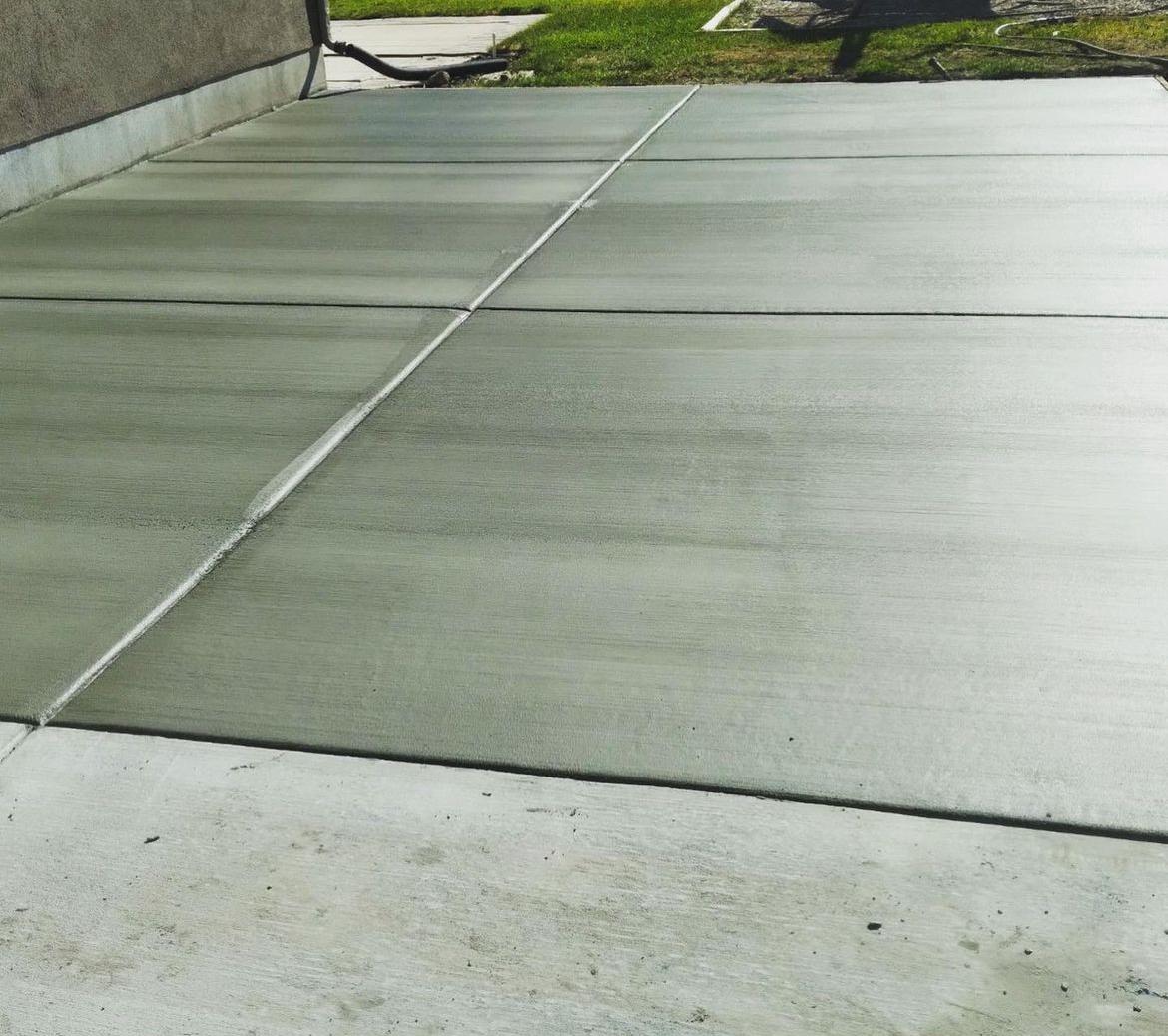
Driveway Replacement for Rental Property Owners in Utah: Cost, Timing & Tax Treatment
Quick answer: Replacing a concrete driveway on a Utah rental runs $8–$13 per sq ft installed — typically $5,500–$14,000 total on a 600–1,100 sq ft single-family rental. The work is generally treated as a 15-year land improvement for depreciation, not a Section 179 expense (confirm with your CPA). The best operational window is the 10–14 day gap between tenants, so timing the pour 7–10 days before move-in lets the slab cure enough to drive on. Spec for rental use: 5” thickness, 4,000 PSI, thickened edges, and saw-cut control joints — the durability premium over a 4” pour is small but materially lowers turnover-cycle repair cost.
If you own single-family rentals, duplexes, or small multi-units in Salt Lake County, Utah County, or Davis County, the driveway is usually the most-used impervious surface on the property and the one that ages fastest. Tenants don’t baby a rental driveway the way an owner-occupant babies theirs — trucks parked on edges, oil leaks, snow shovels scraping the surface, occasional jacking up vehicles on the slab. Add freeze-thaw and the original 1960s–1990s thin slabs most older Wasatch Front rentals were built with, and the driveway often hits replacement age 10–15 years before the rest of the property.
Replacing a rental driveway is a different decision than replacing your own. The math, the timing, the spec, and the tax treatment all shift. This is how to think about it.
Repair, Resurface, or Replace?
The first decision is whether the slab needs full replacement at all. The honest call:
- Crack repair + resealing: Right move if cracks are hairline (under 1/8”), the slab is otherwise flat, and there’s no settling. Buys 5–10 more years. Cost: $400–$1,200.
- Slab jacking (mudjacking / polyurethane): Right move if the slab itself is structurally sound but one or two panels have settled. Cost: $600–$2,500. Note: we don’t perform slab jacking — refer to a specialty contractor.
- Resurfacing (overlay): Cosmetic-only fix. Doesn’t solve structural problems. Rarely the right move on a rental because the overlay fails fast under heavy use.
- Full replacement: Right move if you have wide cracks, multiple settled panels, edge spalling, exposed rebar, or the slab is already thin (under 4”). On a rental, full replacement reset the clock to 30+ years instead of buying 5–10 of patchwork.
The rental-specific calculation: every callback for a driveway problem is a property-management cost you don’t pay on a 30-year slab. If you’re looking at $1,500 in repairs and the slab will need replacement in 3–5 years anyway, the math almost always favors replacing now — especially if there’s a between-tenants window. Our deeper post on why cheap concrete bids cost more covers this trade-off in more detail.
The Right Spec for a Rental Driveway
The temptation on a rental is to spec down — thinner slab, no rebar, no edge thickening — to keep the bid under $7,000. That spec saves about $1,200 up front and costs you 8–10 years of useful life. Spec a rental driveway the way you’d spec your own, with one upgrade: heavier edges, because tenants park on them.
- Thickness: 5” standard. The $1,000 premium over a 4” pour roughly doubles the slab’s practical life under tenant use.
- Concrete strength: 4,000 PSI minimum with 5–7% air entrainment (required for Utah freeze-thaw — non-negotiable).
- Reinforcement: #3 rebar on 18” centers, both directions. Fiber-only is fine for residential driveways under light use; on a rental, the rebar pays for itself in cracking resistance.
- Base: 4” of compacted 3/4” road base over compacted native soil. Verify compaction at 95% Standard Proctor.
- Edge detail: Thickened edges (6” minimum at slab edges and turning points). This is the single highest-ROI spec upgrade on a rental.
- Control joints: Saw-cut every 8–10 feet, no tool joints. Saw cuts crack predictably; tool joints don’t.
- Slope: 1/4” per foot away from the house, with no ponding zones near the foundation or sidewalk.
- Finish: Light broom finish — non-slip, doesn’t show wear, easy for the next contractor to repair to match.
Our post on how thick a concrete driveway should be covers the structural logic; for rentals, default to the higher end of every range.
Timing the Pour Around Tenants
The best operational window for a driveway replacement is the gap between tenants. Concrete needs roughly 7 days before it can handle passenger-car traffic and 28 days to reach full design strength, but the practical move-in timeline is:
| Day | What’s Happening | What’s Allowed |
|---|---|---|
| Day 0 | Tear-out, base prep, pour | No traffic, no foot traffic on slab |
| Days 1–3 | Initial cure, sealing | Foot traffic only after 24 hours |
| Day 7 | ~70% design strength | Passenger vehicle traffic OK |
| Day 14 | ~85% design strength | Light trucks, occasional heavy load |
| Day 28 | Full design strength | All loads including moving trucks |
Practical implication: pour the driveway at least 7–10 days before the new tenant’s move-in date, and ideally 14 days if a moving truck or U-Haul will be loaded on the slab during move-in. A 26-ft moving truck loaded at gross vehicle weight will damage a 3-day-old slab.
If you can’t time around a tenancy gap, the next-best window is late spring through early fall (the same window we cover in best time to pour concrete in Utah). Pouring in active winter is possible but requires blankets, accelerators, and adds 8–15% to the cost.
2026 Cost Ranges by Property Type
| Property Type | Typical Driveway Area | Per Sq Ft Installed | Typical Project Range |
|---|---|---|---|
| Single-family rental, narrow lot | 500–700 sq ft | $11–$14 | $5,500–$9,800 |
| Single-family rental, standard suburb | 700–1,100 sq ft | $10–$13 | $7,000–$14,300 |
| Duplex (shared driveway) | 900–1,400 sq ft | $10–$13 | $9,000–$18,200 |
| Small multi-unit (4–6 unit, shared lot) | 1,800–3,500 sq ft | $9–$12 | $16,200–$42,000 |
| Tear-out add-on (existing concrete removal) | Same area | $2–$4 | Add 20–30% to base cost |
Per-sq-ft cost lands lower on bigger projects because mobilization, forming, and finishing have a fixed component. A 600 sq ft pour costs more per square foot than a 2,000 sq ft pour at the same property, even though the total is smaller.
For comparison with the standard owner-occupant pricing band, see our Utah concrete driveway cost guide.
Tax Treatment: It’s Almost Always a Depreciable Improvement
Disclaimer: we’re concrete contractors, not CPAs. Confirm every tax decision with your accountant. What follows is the general framework for how Utah landlords typically treat driveway work, not advice.
A full driveway replacement on a rental property is almost always a capital improvement, not a repair expense, because it materially extends the property’s useful life and adds value. That means it gets depreciated rather than deducted in the year of the work. For rental real estate:
- Driveways, sidewalks, parking surfaces: Generally classified as land improvements, which depreciate over 15 years using the 150% declining balance method under MACRS (Modified Accelerated Cost Recovery System).
- Bonus depreciation: 15-year property qualifies for bonus depreciation in the year placed in service. The bonus percentage steps down each year — 2026 is at 40% — so confirm the current rate with your CPA before assuming a number.
- Repairs vs improvements: Crack repair and resealing are typically deductible repairs (fully expensed in the year of the work). Full replacement is almost always a capital improvement. The distinction matters for cash flow timing.
- Cost segregation: Worth asking your CPA about if you’re doing a larger multi-unit driveway replacement — segregating the land improvement from the building depreciation schedule can accelerate deductions.
The practical takeaway: keep clean records of the driveway invoice, your before/after photos, the date of substantial completion, and a one-line note on the work scope. Your CPA needs all four to apply the correct treatment.
The Tripping-Hazard Liability Most Landlords Underweight
Utah’s slip-and-fall standard for rental properties holds the landlord to a reasonable-care duty for the common-area and approach surfaces of the property. A driveway with a 1.5”+ vertical displacement crack, a settled panel that creates a step, or an edge that’s spalled into loose chunks is a known hazard. If a tenant, a tenant’s guest, or a service person trips and is injured, the maintenance history of the driveway becomes the first thing the plaintiff’s attorney asks about.
The insurance angle: most Utah landlord policies cover the liability, but rates and renewability are affected by claims. A $7,000 driveway replacement is a smaller cost than a single liability claim, and it removes the hazard from the property’s risk profile.
The practical move on inherited problem driveways: document the condition before you replace, replace cleanly, and keep the invoice. If a claim ever arises tied to the old slab’s condition, you have a record of when and how you remediated.
Picking a Contractor for Rental Work
Rental driveway work is a different fit than custom residential work. Three things to ask before signing:
- Can you hit a tight between-tenants window? A custom-residential contractor often books out 6–10 weeks. For rentals, you usually need a 2–3 week lead time and a firm pour date. Some contractors won’t commit to that; some will.
- Will you provide a detailed invoice suitable for depreciation records? A clean invoice showing scope, square footage, materials, and substantial completion date is what your CPA needs. A handwritten receipt isn’t enough.
- Are you licensed and insured? A licensed B100 contractor on a rental property protects you from the worst case: a contractor injures themselves on your slab, doesn’t have workers’ comp, and your landlord policy gets the claim. Verify license status on the Utah DOPL portal before signing.
Our broader guide on choosing a concrete contractor in Salt Lake City covers the rest of the vetting process.
Our Take
The driveway on a Utah rental is one of the few capital improvements where the math is almost always cleaner than landlords assume: the upgrade from a thin failing slab to a properly specced 5” pour resets the clock to 30+ years, removes a recurring callback line item, eliminates a known liability exposure, and depreciates over 15 years against the rental’s income. The trap is undersizing the spec to save $1,200 on the bid and getting 12 years of life instead of 30. On a rental, the long-life pour is the one that pencils.
The other trap is missing the timing window. The 10–14 day gap between tenants is the operationally cleanest moment to pour, and it gets harder to find if you wait until the current tenant complains about a hazard. Replacing on your schedule, not on a complaint timeline, is the higher-leverage move.
Replacing a Rental Driveway in Utah?
We work with Wasatch Front landlords on between-tenants pours, multi-property scheduling, and clean depreciation-ready invoicing. Free walkthrough and bid.
Get Your Free Estimate