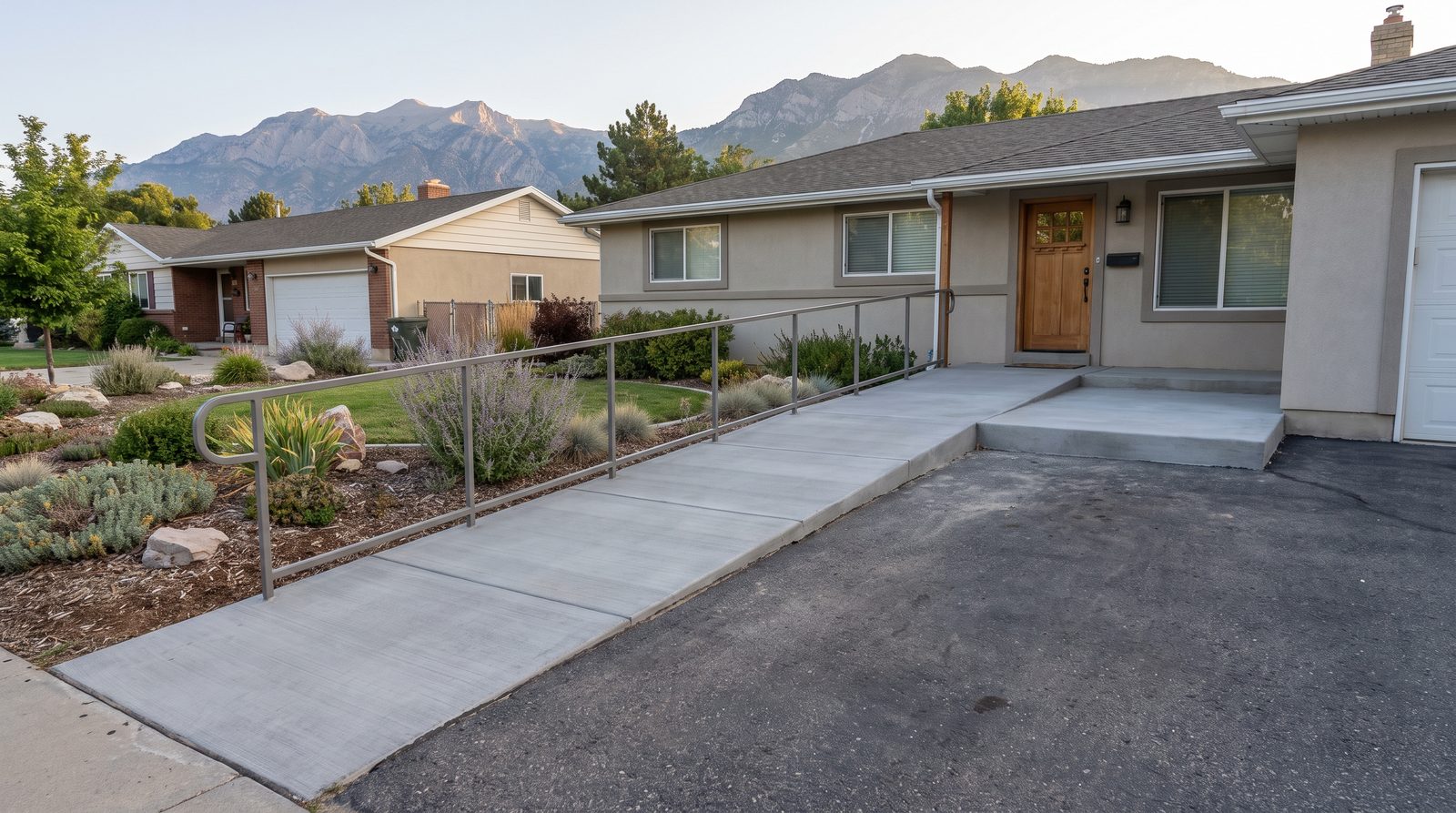
Concrete Ramps for Wheelchair Accessibility at Home: Slope, Cost & Utah Code
Quick answer: A concrete wheelchair ramp at a Utah home runs $2,400–$7,500 installed for most single-entry projects, driven almost entirely by how tall the entry is. The math that matters: at the recommended 1:12 slope, every inch of rise needs 12 inches of ramp. A typical 24” porch needs 24 feet of ramp plus a 5’×5’ level landing at the top and bottom — which is why the right answer on many Utah lots is a switchback layout or a regraded walkway instead of one long straight run. Concrete costs more up front than a wood ramp but is the only option that doesn’t rot, flex, or turn slick with algae — and with a broom finish and air-entrained mix it handles Utah freeze-thaw for decades.
Most calls we get about ramps come at a bad time: a parent is coming home from rehab after a fall or a stroke, the discharge date is two weeks out, and the front entry has three steps. If that’s you, here’s the honest version of what a permanent concrete ramp involves in Utah — the slope math, the real costs, and the cases where a ramp isn’t actually the best fix.
The Slope Math Decides Everything
Ramp cost isn’t priced by the square foot so much as by the rise. The ADA standard — which is the benchmark worth building to even though it doesn’t legally apply to private homes — caps slope at 1:12: one inch of vertical rise per twelve inches of ramp length. Utah’s residential building code (based on the IRC) also uses 1:12 as the ceiling for egress ramps and requires a handrail on any ramp steeper than 1:12.
- 12” rise (2 steps): 12 feet of ramp
- 24” rise (typical porch): 24 feet of ramp
- 36” rise (raised entry): 36 feet of ramp, plus an intermediate landing — ADA caps any single run at 30” of rise before a level rest landing
Add a level 5’×5’ landing at the top (so the door can open without the chair rolling backward) and a level pad at the bottom, and a “three steps up” entry becomes a 30+ foot concrete structure. That’s the part that surprises homeowners — and it’s why the layout conversation matters more than the concrete itself.
When the Yard Is Too Short: Three Layout Options
- Straight run — cheapest per foot, but needs the full length in one line. Works on deep front yards and side yards.
- Switchback (L or U shape) — folds the run back on itself with a 5’×5’ turning landing at each corner. Adds ~$400–$900 per landing but fits tight Utah lots. This is what we build most often.
- Regraded walkway — the option almost nobody considers. If the entry is 12–18” above grade and the walk is long enough, we can often demo the existing walk and re-pour it as one continuous gentle slope from the driveway to the door — no visible “ramp,” no railings, better curb appeal, and usually cheaper than a ramp with landings. If you’re already replacing a settled walk on an older home, this pairs naturally — see our post on concrete walkways for older Utah homes.
2026 Cost: Concrete Ramp by Entry Height
| Entry Rise | Ramp + Landings Needed | Typical Layout | 2026 Installed Cost |
|---|---|---|---|
| 6–12” (1–2 steps) | 6–12 ft run + bottom pad | Straight run or regraded walk | $2,400–$3,800 |
| 18–24” (porch) | 18–24 ft run + top & bottom landings | Straight or single switchback | $3,800–$5,800 |
| 30–36” (raised entry) | 30–36 ft + intermediate rest landing | Switchback (L or U) | $5,500–$7,500+ |
| Walkway regrade alternative | Re-pour existing walk at gentle slope | 12–18” rise only | $2,000–$4,500 |
| Handrail (both sides, steel) | Required over 1:12; strongly recommended always | Add-on | $60–$110 per linear ft |
Ranges assume normal access for forms and the concrete truck. Demo of existing steps or walk, tree roots, and sprinkler line relocation add cost — the estimate visit catches those.
Concrete vs Wood vs Aluminum
| Material | Installed Cost (24” rise) | Lifespan in Utah | The Catch |
|---|---|---|---|
| Concrete | $3,800–$5,800 | 30+ years | Highest up-front cost; permanent (a plus for resale on ramblers, a minus if you want it gone later) |
| Wood | $1,800–$3,500 | 8–15 years | Annual sealing, gets slick with frost and algae, flexes under power chairs (most weigh 250–400 lbs before the rider) |
| Aluminum (modular) | $2,500–$5,000 | 15–25 years | Fast install and removable — the right call for short-term needs — but loud, industrial-looking, and hot in direct summer sun |
Our honest guidance: if the need is temporary (post-surgery recovery measured in months), rent or buy a modular aluminum ramp. If the need is permanent — aging in place, a progressive condition, a family member using a power chair — concrete is cheaper per year of service than anything else and it’s the only option that also raises usability for strollers, walkers, and delivery carts without maintenance.
Spec That Survives Utah Freeze-Thaw
A ramp is the one piece of flatwork where surface condition is a safety issue, not a cosmetic one. Utah’s 100+ freeze-thaw cycles a year will scale and pit a badly specified ramp fast — and a scaled surface under a wheelchair wheel in January is dangerous. The spec we pour:
- 4” slab, 4,000 PSI, 5–7% air entrainment — the same freeze-thaw armor we put in driveways (here’s why air entrainment matters in Utah)
- Coarse broom finish, brushed across the direction of travel — traction for wheels going up, braking going down
- Compacted gravel base with the ramp tied to the porch/foundation so the top of the ramp can’t settle away from the door threshold — a ¾” lip at the top is the most common failure we see on ramps other people poured
- 2” curb or edge protection along open sides so a wheel can’t drop off the edge
- Cross-slope under 2% — enough to shed water so ice doesn’t form in the wheel path, not enough to pull the chair sideways
- No sealer that leaves a film. Penetrating siloxane sealers protect without making the surface glassy. Film-forming acrylics on a ramp are an ice-rink waiting to happen.
Permits and the Discharge-Date Problem
Most Wasatch Front cities treat a residential ramp as regular flatwork — no permit needed unless it ties into a public sidewalk, involves structural footings at the entry, or exceeds 30” of height (which triggers guardrail requirements under the residential code). We confirm with the specific city on every job; it’s a same-day phone call, not a weeks-long process.
On timeline: forming and pouring a ramp is typically a 2–3 day job, but concrete needs 7 days of cure before wheelchair use (full design strength at 28). If you have a hospital discharge date, count backward: we need the pour done at least a week before the person comes home. If the date is too close, the right sequence is a rented aluminum ramp for month one while the concrete goes in properly — we’d rather tell you that than rush a pour.
Mistakes We Get Called to Fix
- Ramps built at 1:8 or steeper to save length. Manageable downhill for an attendant, genuinely unsafe for a self-propelled manual chair. If the lot can’t fit 1:12, change the layout — don’t change the slope.
- No top landing. The user has to hold position on the slope while unlocking and pulling open the door. This is the single most common DIY design error.
- Smooth-troweled surface — looks premium, becomes a slide the first frosty morning.
- Wood ramp screwed to the porch of a home that’s about to be listed. Buyers see a liability; a poured ramp with clean lines or a regraded walkway reads as a feature, especially on single-level homes marketed to retirees.
- Ignoring the steps entirely. If the household still has able-bodied members, keep the steps and add the ramp beside them — and if the steps themselves are crumbling, handle both in one mobilization. See our guide to porch and step replacement on older Utah homes.
As with any flatwork, the contractor matters more than the material — our guide to choosing a concrete contractor in Salt Lake City covers the licensing and bid-comparison questions that apply here too.
Need an Accessible Entry, Done Right?
We pour wheelchair ramps, regraded walkways, and step replacements across Salt Lake County, Utah County, and Davis County — measured to true 1:12, finished for traction, built for Utah winters. Estimates are free and we’ll tell you honestly if a ramp isn’t the best option for your entry.
Get Your Free Estimate