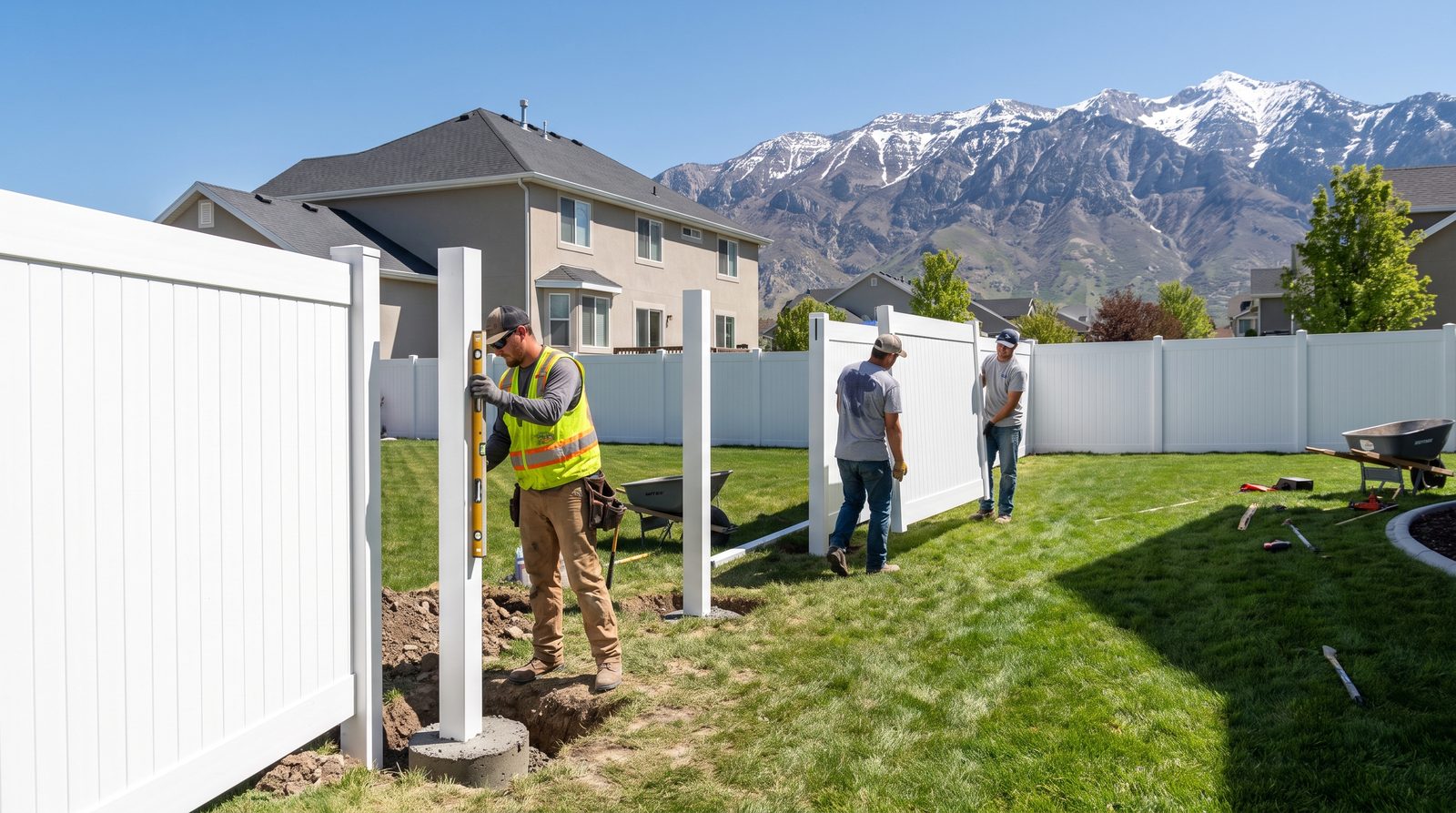
Vinyl Fence Installation Cost in Utah (2026): Price Per Foot & What Drives It
Quick answer: Professionally installed 6-foot vinyl privacy fence runs $25–$45 per linear foot in Utah in 2026, posts set in concrete included. A typical 150-linear-foot backyard lands at $4,000–$7,000 with a gate. Tearing out an old fence adds $3–$6 per foot, gates run $350–$700 each, and the two specs worth paying for here are reinforced rails for canyon wind and post footings below frost depth.
Vinyl is the default fence along the Wasatch Front for a reason: it shrugs off sprinkler overspray, doesn’t need staining every three years, and the good product handles our sun and freeze-thaw for decades. But quotes for the same yard routinely come back $2,000 apart, and the difference is almost never the panels — it’s what’s underground and inside the rails. Here’s how the pricing actually works.
Vinyl Fence Cost Per Linear Foot in Utah (2026)
| Style | Typical Height | Installed Cost / Linear Foot |
|---|---|---|
| Picket / decorative | 4 ft | $20–$30 |
| Semi-privacy (spaced board) | 5 ft | $22–$35 |
| Full privacy | 6 ft | $25–$45 |
| Privacy with lattice top | 6–7 ft | $30–$50 |
| Walk gate | — | $350–$700 each |
| Double drive / RV gate | — | $700–$1,200 |
Those are all-in numbers — materials, posts, concrete footings, hardware, and labor. Material alone is roughly half, which is why a quote that’s dramatically under this range usually means the installer is saving money somewhere you can’t see.
What a Full Project Costs
| Project | Linear Feet | Typical 2026 Range |
|---|---|---|
| Side-yard section with walk gate | ~60 lf | $1,900–$3,300 |
| Standard backyard, one gate | ~150 lf | $4,000–$7,000 |
| Full perimeter, corner lot, two gates | ~300 lf | $8,200–$14,500 |
The 7 Things That Move Your Price
- Linear footage — the obvious one, but note that longer runs get a better per-foot rate. Mobilization costs the same whether we install 60 feet or 300.
- Tear-out of the old fence — removing and hauling an existing wood or chain-link fence adds $3–$6 per linear foot, more if old posts were set in oversized concrete.
- Height and style — each foot of height adds material and wind load. Lattice tops and transitions between heights add labor.
- Gates — the most underestimated line item. A gate is the only part of a fence with moving parts, and drive gates need heavier posts and more concrete.
- Slope — sloped yards need either racked panels or stepped sections, and stepping adds cuts, posts, and time. Most bench-area lots in Draper, Sandy, and South Jordan have at least some grade to deal with.
- Digging conditions — post holes in soft loam and post holes in the rocky, compacted fill common on Wasatch bench lots are different jobs. Rock digging can add 10–20% to labor.
- HOA and city requirements — most Utah cities don’t require a permit for a standard 6-foot residential fence, but corner lots have sight-triangle rules near intersections, and HOAs in Daybreak, Herriman, and much of Utah County dictate color, height, and sometimes brand. Check before you order material, not after.
The Two Specs a Utah Vinyl Fence Has to Get Right
Wind
A 6-foot privacy panel is a sail. Canyon winds along the east bench and through Davis County regularly gust past 60 mph, and the failure mode is always the same: bottom rails fold, then posts snap or rotate in undersized footings. The fix is spec, not luck — steel- or aluminum-reinforced bottom rails, posts every 6 feet in wind corridors (8-foot spacing is fine in sheltered valley neighborhoods), and footings sized to the panel, not to whatever bag count the installer had on the truck.
Frost
Frost depth along the Wasatch Front is roughly 30 inches. Posts set shallower than that will heave — the same freeze-thaw mechanics that crack Utah concrete will pump a shallow fence post out of the ground a little more each winter until gates stop latching and the fence line waves. We set posts 30–36 inches deep in poured concrete footings, which is also why a fence is a natural add-on to a concrete project: the digging equipment and the concrete are already on site.
Vinyl vs Wood vs Chain Link, Briefly
Vinyl costs more on day one than wood ($25–$45/lf vs roughly $18–$35/lf installed) and it’s not close over ten years, once wood’s staining, sealing, and board replacement enter the math — the full 10-year cost breakdown is in our vinyl vs wood comparison. Quality vinyl in Utah’s climate is a 25–30 year fence; what determines whether yours actually gets there is covered in how long a vinyl fence really lasts. Chain link still wins on pure price for utility runs, but nobody has ever asked us to make it beautiful.
One material note worth paying for: virgin vinyl with titanium dioxide (TiO2) UV inhibitor. Utah’s high-altitude sun is brutal on cheap recycled-blend panels — they’re what you’re seeing when a white fence has gone chalky yellow in five years.
What Installation Looks Like
- Before anything digs: Blue Stakes of Utah (811) locates buried utilities — required by law, free, and scheduled by us, not you.
- Day 1: Layout, string lines, post holes, posts set in concrete. Footings cure overnight minimum.
- Day 2–3: Rails, panels, gates, hardware, cleanup. A typical 150-foot backyard is a 2–3 day job.
Fencing also bundles well: fence plus landscaping, patio, or a full backyard transformation in one mobilization is consistently cheaper than hiring the trades separately — the crew, the digging equipment, and the concrete are already there.
Get a Fence Quote That Specs the Wind and the Frost
Free on-site estimates across Salt Lake, Utah, and Davis Counties — measured, itemized, and honest about what your lot actually needs. Bundle a fence with concrete or landscaping and save on the combined project.
Get Your Free Estimate